Percepciones negativas del alumnado sobre el uso de la IA en la escritura académica: implicaciones didácticas para la Educación Superior
DOI:
https://doi.org/10.5944/educxx1.43943Palabras clave:
alumnado, aspectos negativos, educación superior, inteligencia artificial, método ReinertResumen
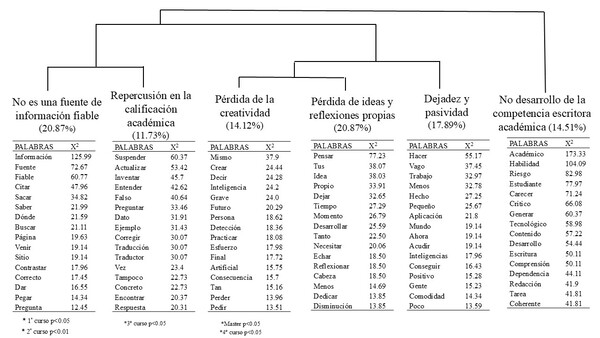
La inteligencia artificial (IA) está ganando terreno en la redacción en la educación superior. Su uso fomenta una visión global y pluricultural en la enseñanza, además de impulsar la comunicación académica y la difusión de investigaciones. Sin embargo, no pueden evaluarse estos beneficios sin tener en cuenta la opinión de los estudiantes. Este estudio analiza los aspectos negativos los estudiantes identifican al utilizar IA en sus trabajos universitarios. Se encuestó a 314 estudiantes de grado y posgrado en el ámbito de educación educación y los resultados se examinaron mediante el método Reinert. Los hallazgos revelan que los aspectos negativos están vinculados a la ausencia de ética académica y a la pérdida de habilidades como la creatividad. Asimismo, se identifica un impacto en el desarrollo de la competencia escritora. Fruto de estos resultados, se reflexiona acerca de las implicaciones didácticas del estudio y de las medidas que podrían adoptarse desde las instituciones de educación superior para promover un uso responsable y provechoso de la IA en el ámbito educativo.
Descargas
Citas
Agee, J. (2009). Developing qualitative research questions: a reflective process. International Journal of Qualitative Studies in Education, 22(4), 431–447. https://doi.org/10.1080/09518390902736512
Alharbi, W. (2023). AI in the foreign language classroom: A pedagogical overview of automated writing assistance tools. Educational Research International. 4253331. https://doi.org/10.1155/2023/4253331
Ansar, W., & Goswami, S. (2021). Combating the menace: A survey on characterization and detection of fake news from a data science perspective. International Journal of Information Management Data Insights, 1(2), 100052. https://doi.org/10.1016/j.jjimei.2021.100052
Bearman, M., Ryan, J., & Ajjawi, R. (2022). Discourses of artificial intelligence in higher education: A critical literature review. Higher Education, 1–17. https://doi.org/10.1007/s10734-022-00937-2
Bedington, A., Halcomb, E. F., McKee, H. A., Sargent, T., & Smith, A. (2024). Writing with generative AI and human-machine teaming: Insights and recommendations from faculty and students. Computers and Composition, 71, 102833. https://doi.org/10.1016/j.compcom.2024.102833
Boillos, M. M., Bereziartua, G., & Idoiaga, N. (2024). The decision to publish in a minority language: the case of the Basque language. International Multilingual Research Journal, 19(1), 23–35. https://doi.org/10.1080/19313152.2024.2311508
Camargo, B. V., & Bousfield, A. B. S. (2009). Social representations, risk behaviors and AIDS. The Spanish Journal of Psychology, 12(2), 565–575. https://doi.org/10.1017/S1138741600001931
Chan, C. K. Y. (2023). A comprehensive AI policy education framework for university teaching and learning. International Journal of Educational Technology in Higher Education, 20(1), 38. https://doi.org/10.1186/s41239-023-00408-3
Chicaiza, S. M., López, F. L., López, N. A., & Ochoa, G. X. (2024). Impacto de la Inteligencia Artificial (IA) en la Educación Superior. RECIAMUC, 8(2), 80-91. https://doi.org/10.26820/reciamuc/8.(2).abril.2024.80-91
Dergaa, I., Chamari, K., Zmijewski, P., & Saad, H. B. (2023). From human writing to artificial intelligence generated text: examining the prospects and potential threats of ChatGPT in academic writing. Biology of sport, 40(2), 615-622. https://doi.org/10.5114/biolsport.2023.125623
Firat, M. (2023). What ChatGPT means for universities: Perceptions of scholars and students. Journal of Applied Learning and Teaching, 6(1), 57–63. https://doi.org/10.37074/jalt.2023.6.1.22
Floridi, L. (2019). What the near future of artificial intelligence could be. Philosophy and Technology, 32(1), 1–15. https://doi.org/10.1007/s13347-019-00345-y
Friederich, S., & Symons, J. (2023). Norms for Academic Writing in the era of advanced Artificial Intelligence. Digital Society, 2(48). https://doi.org/10.1007/s44206-023-00079-7
Fryer, L. K., Nakao, K., & Thompson, A. (2019). Chatbot learning partners: Connecting learning experiences, interest and competence. Computers in Human Behavior, 93, 279–289. https://doi.org/10.1016/j.chb.2018.12.023
Garcés, J. R., Aguilar, W. G., Rodríguez, S. D., & Burbano, C. D. (2024). Impacto de la Inteligencia Artificial en la Educación Superior. Dominio de las Ciencias, 10(3), 983–995. https://doi.org/10.23857/dc.v10i3.3967
Gayed, J. M., Carlon, M. K. J., Oriola, A. M., & Cross, J. S. (2022). Exploring an AIbased writing Assistant’s impact on English language learners. Computers and Education: Artificial Intelligence, 3, 100055. https://doi.org/10.1016/j.caeai.2022.100055
Humble, N., & Mozelius, P. (2022). The threat, hype, and promise of artificial intelligence in education. Discover Artificial Intelligence, 2(1), 22. https://doi.org/10.1007/s44163-022-00039-z
Idoiaga, N., & Belasko, M. (2019). Understanding menstruation: influence of gender and ideological factors. A study of young people´s social representations. Feminism & Psychology, 29(3), 357-373. https://doi.org/10.1177/0959353519836445
Idoiaga-Mondragon, N., Eiguren Munitis, A., Ozamiz-Etxebarria, N., & Alonso Saez, I. (2025). Let Us Educate on Pornography: Young Education Students’ Representations of Pornography. Sexuality Research and Social Policy, 22, 268–278. https://doi.org/10.1007/s13178-023-00930-z
Idoiaga Mondragon, N., Berasategi Sancho, N., Eiguren Munitis, A., & Dosil Santamaria, M. (2021). Exploring the social and emotional representations used by students from the University of the Basque Country to face the first outbreak of COVID-19 pandemic. Health Education Research, 36(2), 159-169. https://doi.org/10.1093/her/cyab006
Joffe, H., & Elsey, J. W. (2014). Free association in psychology and the grid elaboration method. Review of General Psychology, 18(3), 173-185. https://doi.org/10.1037/gpr0000014
Kasneci, E., K. Sessler, S. Küchemann, M. Bannert, D. Dementieva, F. Fischer, U. Gasser, et al. (2023). ChatGPT for Good? On Opportunities and Challenges of Large Language Models for Education. Learning and Individual Differences, 103, 102274. https://doi.org/10.1016/j.lindif.2023.102274
Khalifa, M., & Albadawy, M. (2024). Using artificial intelligence in academic writing and research: An essential productivity tool. Computer Methods and Programs in Biomedicine Update, 100145. https://doi.org/10.1016/j.cmpbup.2024.100145
Klein, O., & Licata, L. (2003). When group representations serve social change: The speeches of Patrice Lumumba during the Congolese decolonization. British Journal of Social Psychology, 42(4), 571–593. https://doi.org/10.1348/014466603322595284
Kruse, O., & Anson, C.M. (2023). Writing and Thinking: What Changes with Digital Technologies? In O. Kruse, C. Rapp, C. M. Anson, K. Benetos, E. Cotos, A. Devitt & A. Shibaniet. Digital Writing Technologies in Higher Education (pp. 465-484). Springer. https://doi.org/10.1007/978-3-031-36033-6_29
Legorburu, I., Idoiaga Mondragon, N., Alonso, I., & Berasategi, N. (2022). Why are you allowed to go to school on your own? Exploring children’s voices on independent mobility. Children & Society, 36(6), 1111-1125. https://doi.org/10.1111/chso.12559
Lund, B. D., & Wang, T. (2023). Chatting about ChatGPT: How may AI and GPT impact academia and libraries? Library Hi Tech News, 40(3), 26–29. https://doi.org/10.1108/LHTN-01-2023-0009
Malik, A. R., Pratiwi, Y., Andajani, K., Numertayasa, W., Suharti, S., Darwis, A., & Marzuki (2023). Exploring Artificial Intelligence in Academic Essay: Higher Education Student’s Perspective. International Journal of Educational Research Open, 5, 1-11, https://doi.org/10.1016/j.ijedro.2023.100296
Molenaar, I. (2022). The Concept of Hybrid Human-AI Regulation: Exemplifying how to Support Young Learners’ Self-Regulated Learning. Computers and Education: Artificial Intelligence, 3, 100070. https://doi.org/10.1016/j.caeai.2022.100070
Marchand, P., & Ratinaud, P. (2012). L’analyse de similitude appliquée aux corpus textuels: les primaires socialistes pour l’élection présidentielle française. 11èmes Journées internationales d’Analyse statistique des Données Textuelles, Liège, Belgique, septembre-octobre 2011.
Nguyen, A., Ngo, H. N., Hong, Y., Dang, B., & Nguyen, B.-P. T. (2023). Ethical Principles for Artificial Intelligence in Education. Education and Information Technologies, 28, 4221-4241 https://doi.org/10.1007/s10639-022-11316-w
Nguyen, A., Hong, Y., Dang, B., & Huang, X. (2024). Human-AI collaboration patterns in AI-assisted academic writing, Studies in Higher Education, 49(5), 847–864. https://doi.org/10.1080/03075079.2024.2323593
Ou, A. W., Stöhr, C., & Malmström, H. (2024). Academic communication with AIpowered language tools in higher education: From a post-humanist perspective. System, 121, 103225. https://doi.org/10.1016/j.system.2024.103225
Ratinaud, P. (2009). IRAMUTEQ: Interface de R pour les Analyses Multidimensionnelles de Textes et de Questionnaires [Computer software]. http://www.iramuteq.org
Ratinaud, P., & Marchand, P. (2012). Application de la méthode ALCESTE à de “gros” corpus et stabilité des “mondes lexicaux”: analyse du “Cable- Gate” avec IraMuTeQ. In Actes des 11eme Journées internationales d’Analyse statistique des Données Textuelles (pp. 835–844). JADT.
Ray, P. P. (2023). ChatGPT: A comprehensive review on background, applications, key challenges, bias, ethics, limitations and future scope. Internet of Things and Cyber Physical Systems, 3, 121–154. https://doi.org/10.1016/j.iotcps.2023.04.003
Reinert, A. (1983). Une méthode de classification descendante hiérarchique: application à l’analyse lexicale par contexte. Cahiers de l’Analyse des Données, 8(2), 187–198.
Rodríguez, Á., Orozco, K., García, J., & Rodríguez, S. (2023). La Implementación de la Inteligencia Artificial en la Educación: Análisis Sistemático. Dominio de las Ciencias, 9, 2162–2178. https://doi.org/10.23857/dc.v9i3.3548
Thorp, H. H. (2023). ChatGPT is fun, but not an author. Science, 379(6630), 313. https://doi.org/10.1126/science.adg7879
Tlili, A., Shehata, B., Adarkwah, M. A., Bozkurt, A., Hickey, D. T., Huang, R., & Agyemang, B. (2023). What if the devil is my guardian angel: ChatGPT as a case study of using chatbots in education. Smart Learning Environments, 10(1), 15. https://doi.org/10.1186/s40561-023-00237-x
van Dis, E. A. M., Bollen, J., Zuidema, W., van Rooij, R., & Bockting C. L. (2023). ChatGPT: five priorities for research. Nature, 614(7947), 224–226. https://doi.org/10.1038/d41586-023-00288-7
Descargas
Publicado
Cómo citar
Número
Sección
Licencia
Derechos de autor 2025 Mari Mar Boillos Pereira, Nahia Idoiaga

Esta obra está bajo una licencia internacional Creative Commons Atribución-NoComercial 4.0.
La revista Educación XX1 se publica bajo licencia Creative Commons Reconocimiento-NoComerciaL 4.0 (CC BY-NC 4.0). Se permite la generación de obras derivadas siempre que no se haga un uso comercial. Tampoco se puede utilizar la obra original con finalidades comerciales.