La sutil agresión de la exclusión social en la escuela: una escala de medida para adolescentes
The subtle aggression of social exclusion in education: a scale for its measurement among young people
DOI:
https://doi.org/10.5944/educxx1.39860Palabras clave:
agresión, victimización, escalas, discriminación social, adolescentes, educaciónResumen
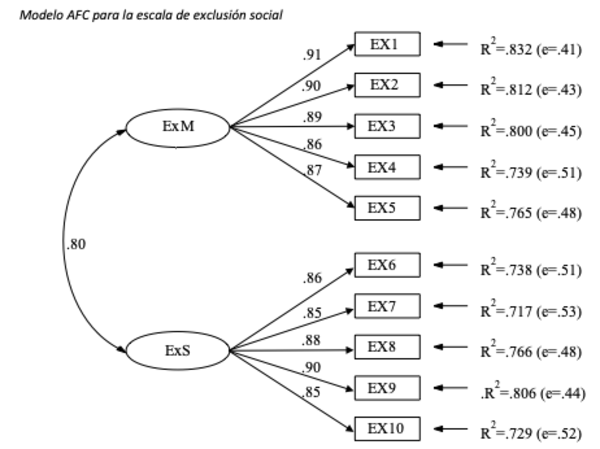
La literatura científica ha explicado ampliamente el constructo exclusión social. Sin embargo, son escasos los estudios que abordan las importantes diferencias y tipos de marginación o exclusión social en el marco de la convivencia escolar. Igualmente son pocos los estudios que focalizan el estudio del fenómeno durante la pubertad y la adolescencia. El objetivo de este trabajo ha sido describir los matices del fenómeno y diseñar y validar una escala para su medida (ESMASU). En este trabajo participaron 1013 estudiantes de Educación Primaria y Secundaria de centros educativos de Córdoba. La investigación se desarrolló en dos fases: la primera exploró la idoneidad y la estructura de un instrumento sobre exclusión social que recoge los matices afectivos y conductuales referidos a los sentimientos de la victima de los diferentes tipos de exclusión. En la segunda, mediante un análisis factorial confirmatorio se establece la estructura factorial de una escala de medida que evidencia buenas cualidades psicométricas para la evaluación del constructo exclusión social. Así se obtiene una escala de dos factores -exclusión sutil y exclusión manifiesta- Se discuten los resultados en relación a la idoneidad del instrumento y se expresan las conclusiones en orden tanto a la aportación que el articulo hace a la comprensión del constructo como a su virtualidad para favorecer intervenciones educativas preventivas y paliativas de este tipo de agresión entre iguales.
Descargas
Citas
Alivernini, F., & Manganelli, S. (2016). The Classmates Social Isolation Questionnaire (CSIQ): An initial validation. European Journal of Developmental Psychology, 13, 264-274 https://doi.org/10.1080/17405629.2016.1152174
Arslan, G. (2018). School-based social exclusion, affective wellbeing, and mental health problems in adolescents: A study of mediator and moderator role of academic self-regulation. Child Indicators Research, 11(3), 963–980. https://doi.org/10.1007/s12187-017-9486-3
Banki, S. (2012). How much or how many? Partial ostracism and its consequences. [Unpublished doctoral dissertation]. University of Toronto, Toronto, Canada. https://hdl.handle.net/1807/32659
Baumeister, R. F., & Leary, M. R. (1995). The need to belong: Desire for interpersonal attachments as a fundamental human motivation. Psychological Bulletin, 117(3), 497–529. https://doi.org/10.1037/0033-2909.117.3.497
Bentler, P. M. (1992). On the fit of models to covariances and methodology to the Bulletin. Psychological Bulletin, 112, 400-404. https://doi.org/10.1037/0033-2909.112.3.400
Bravo, A., Ortega-Ruiz, R., Veenstra, R., Engels, M. C., & Romera, E. M. (2022). Friendship selection and influence processes for popularity in early and midadolescents. Journal of Adolescence, 94(1), 45–56. https://doi.org/10.1002/jad.12004
Cerezo, F. (2000). Bull- S. Test de Evaluación de la Agresividad entre Escolares. Albor-Cohs.
Chen, Z., Poon, K.-T., DeWall, C. N., & Jiang, T. (2020). Life lacks meaning without acceptance: Ostracism triggers suicidal thoughts. Journal of Personality and Social Psychology, 119(6), 1423–1443. https://doi.org/10.1037/pspi0000238
Cillessen, A. H. N., & Marks, P. E. L. (2017). Methodological choices in peer nomination research. New Directions for Child and Adolescent Development, 157, 21–44. https://doi.org/10.1002/cad.20206
Falla, D., & Ortega-Ruiz, R. (2019). Los escolares diagnosticados con trastorno del espectro autista y víctimas de acoso escolar: Una revisión sistemática [Students diagnosed with autism spectrum disorder and victims of bullying: A systematic review]. Psicología Educativa, 25(2), 77–90. https://doi.org/10.5093/psed2019a6
Ferrando, P. J., & Lorenzo-Seva, U. (2014). El análisis factorial exploratorio de los ítems: algunas consideraciones adicionales. Anales de Psicología, 30(3), 1170-1175. https://doi.org/10.6018/analesps.30.3.199991
Flora, D. B., & Curran, P. J. (2004). An empirical evaluation of alternative methods of estimation for confirmatory factor analysis with ordinal data. Psychological Methods, 9(4), 466–491. https://doi.org/10.1037/1082-989X.9.4.466
Freedman, G., Williams, K. D., & Beer, J. S. (2016). Softening the blow of social exclusion: The Responsive Theory of Social Exclusion. Frontiers in Psychology, 7, Article 1570. https://doi.org/10.3389/fpsyg.2016.01570
García-Díaz, V., Urbano-Contreras, A., Iglesias-García, M.T., Álvarez-Blanco, L. (2023). Identification, Witnessing and Reaction to School Bullying Behaviour in Secondary Education. Child Indicators Research, 16(4), 1627-1641. https://doi.org/10.1007/s12187-023-10023-3
Gilman, R., Carter-Sowell, A., DeWall, C. N., Adams, R. E., & Carboni, I. (2013). Validation of the Ostracism Experience Scale for Adolescents. Psychological Assessment, 25(2), 319–330. https://doi.org/10.1037/a0030913
Hu, L. T., & Bentler, P. M. (1999). Cutoff criteria for fit indices in covariance structure analysis: Conventional criteria versus new alternatives. Structural Equation Modeling, 6, 1-55.
Kaufman, E., & Killen, M. (2022). Children’s perspectives on fairness and inclusivity in the classroom. Spanish Journal of Psychology, 25(e28), 1-11. https://doi.org/10.1017/SJP.2022.24
Leary, M. R. (2005). Varieties of Interpersonal Rejection. In K. D. Williams, J. P. Forgas, & W. von Hippel (Eds.), The social outcast: Ostracism, social exclusion, rejection, and bullying (pp. 35–51). Psychology Press.
Lee, R. M., & Robbins, S. B. (1995). Measuring belongingness: The Social Connectedness and the Social Assurance scales. Journal of Counseling Psychology, 42(2), 232–241. https://doi.org/10.1037/0022-0167.42.2.232
Lloret, S., Ferreres, A., Hernández, A., & Tomás, I. (2017). El análisis factorial exploratorio de los ítems: análisis guiado según los datos empíricos y el software. Anales de Psicología, 33(2), 417-432. https://doi.org/10.6018/analesps.33.2.270211
Lorenzo-Seva, U. (2003). A factor simplicity index. Psychometrika, 68(1), 49-60. https://doi.org/10.1007/BF02296652
Malone, G. P., Pillow, D. R., & Osman, A. (2012). The General Belongingness Scale (GBS): Assessing achieved belongingness. Personality and Individual Differences, 52(3), 311–316. https://doi.org/10.1016/j.paid.2011.10.027
McKenna-Plumley, P. E., Turner, R. N., Yang, K., & Groarke, J. M. (2023). Experiences of Loneliness Across the Lifespan: A Systematic Review and Thematic Synthesis of Qualitative Studies. International Journal of Qualitative Studies on Health and Wellbeing,
18(1), Article 2223868. https://doi.org/10.1080/17482631.2023.2223868
Moyano, M., Lobato, R. M., Ventsislavova, P., & Trujillo, H. M. (2022). Social inclusion level of Spanish and foreign adolescents: Proposal for an evaluation instrument. Current Psychology, 41, 6880–6893. https://doi.org/10.1007/s12144-020-01201-5
Molden, D. C., Lucas, G. M., Gardner, W. L., Dean, K., & Knowles, M. L. (2009). Motivations for prevention or promotion following social exclusion: Being rejected versus being ignored. Journal of Personality and Social Psychology, 96(2), 415–431. https://doi.org/10.1037/a0012958
Ortega, R. (Coord.) (2010). Agresividad injustificada, bullying y violencia escolar. Alianza Editorial.
Prendergast, C. N., & Schubert, T. (2020). Investigating Reflexive Responses to Explicit and Implicit Forms of Social Exclusion Using Immersive Virtual Environment Technology. Frontiers in Psychology, 11, Article 575783. https://doi.org/10.3389/fpsyg.2020.575783
Riva, P., & Eck, J. (Eds.). (2016). Social exclusion: Psychological approaches to understanding and reducing its impact. Springer Cham. https://doi.org/10.1007/978-3-319-33033-4
Rodríguez-Hidalgo, A.J. & Ortega-Ruiz, R. (2017). Acoso escolar, ciberacoso y discriminación. Educar en diversidad y convivencia. Catarata.
Rodríguez-Hidalgo, A. J., Ortega-Ruiz, R., & Zych, I. (2014). Peer Victimization and Ethnic-Cultural Peer Victimization: Self-Esteem and School Relations between Different Cultural Groups of Students in Andalusia, Spain. Journal of Psychodidactics, 19, 191-210. https://doi.org/10.1387/RevPsicodidact.7909
Russell, D., Peplau, L., & Ferguson, M. L. (1978). UCLA Loneliness Scale [Database record]. APA PsycTests. https://doi.org/10.1037/t05974-000
Satici, B. (2020). Social exclusion and adolescent wellbeing: Stress, school satisfaction, and academic self-efficacy as multiple mediators. The Educational and Developmental Psychologist, 37(1), 67–74. https://doi.org/10.1017/edp.2020.7
Semenova G.V., Vekilova S.A. & Rudykhina O.V. (2022). Social Exclusion: Development and Testing of the Scale. Social Psychology and Society, 13(3), 97–115. https://doi.org/10.17759/sps.2022130307
Vanhalst, J., Soenens, B., Luyckx, K., Van Petegem, S., Weeks, M. S., & Asher, S. R. (2015). Why do the lonely stay lonely? Chronically lonely adolescents’ attributions and emotions in situations of social inclusion and exclusion. Journal of Personality and Social Psychology, 109(5), 932–948. https://doi.org/10.1037/pspp0000051
Wesselmann, E. D., Bradley, E., Taggart, R. S., & Williams, K. D. (2023). Exploring social exclusion: Where we are and where we’re going. Social and Personality Psychology Compass, 17(1), Article e12714. https://doi.org/10.1111/spc3.12714
Williams, K. D., Forgas, J. P., & von Hippel, W. (Eds.). (2005). The social outcast: Ostracism, social exclusion, rejection, and bullying. Psychology Press.
Williams, K. D. (2001). Ostracism: The power of silence. Guilford Press.
Wiltgren, L. (2023). So incredibly equal: how polite exclusion becomes invisible in the classroom. British Journal of Sociology of Education, 44(3), 435–451. https://doi.org/10.1080/01425692.2023.2164844
Yu, X., Du, H., Li, D., Sun, P., & Pi, S. (2023). The Influence of Social Exclusion on High School Students’ Depression: A Moderated Mediation Model. Psychology Research and Behavior Management, 16, 4725–4735. https://doi.org/10.2147/PRBM.S431622
Zadow, C., Rosenberg, M., Wood, L., Qualter, P., & Shilton, T. (2024). Trajectories of Loneliness During Adolescence Predict Subsequent Symptoms of Depression and Positive Wellbeing. Journal of Youth and Adolescence, 53, 1078–1090. https://doi.org/10.1007/s10964-023-01925-0
Descargas
Publicado
Cómo citar
Número
Sección
Licencia
Derechos de autor 2025 Rosa María González Delgado, Rosario Ortega-Ruiz, Irene Dios Sánchez, Antonio Jesús Rodríguez Hidalgo

Esta obra está bajo una licencia internacional Creative Commons Atribución-NoComercial 4.0.
La revista Educación XX1 se publica bajo licencia Creative Commons Reconocimiento-NoComerciaL 4.0 (CC BY-NC 4.0). Se permite la generación de obras derivadas siempre que no se haga un uso comercial. Tampoco se puede utilizar la obra original con finalidades comerciales.