Cambios en la construcción del sí mismo, estructura cognitiva y sintomatología en mujeres con trastorno distímico en terapia de grupo. Comparación con una muestra no clínica
DOI:
https://doi.org/10.33898/rdp.v25i99.83Palabras clave:
Trastorno distímico, Terapia de Grupo, cambio terapéutico, estructura cognitiva, construcción del sí mismo, Técnica de Rejilla, estudio comparativo, estudio de resultadoResumen
El propósito de este estudio es analizar si se han producido cambios en la construcción del sí mismo, en la estructura cognitiva y en la sintomatología ansiosa-depresiva en 19 pacientes diagnosticadas de trastorno distímico tras realizar seis meses de terapia de grupo. Un segundo objetivo que nos hemos planteado, ha sido analizar con medidas test y retest si en una muestra no clínica, pareada en edad, nivel de estudios y ocupación con la muestra clínica, ha habido cambios en la construcción del sí mismo, en la estructura cognitiva tras un lapso de tiempo a los seis meses. Para evaluar estos cambios hemos utilizado la Técnica de la Rejilla de Kelly, el Inventario de Ansiedad Estado-Rasgo (STAI), el Inventario de Depresión de Beck (BDI) y la Escala de Autoestima de Rosemberg. Los resultados revelan que los pacientes con trastorno distímico, tras la terapia de grupo, han tenido un cambio en la construcción del sí mismo y en su estructura cognitiva, no encontrándose este tipo de cambios en la muestra no clínica. Además, en la muestra clínica también se ha obtenido una disminución del nivel de ansiedad y de depresión, junto con un aumento del nivel de autoestima.Descargas
Los datos de descargas todavía no están disponibles.
Descargas
Publicado
2014-11-01
Cómo citar
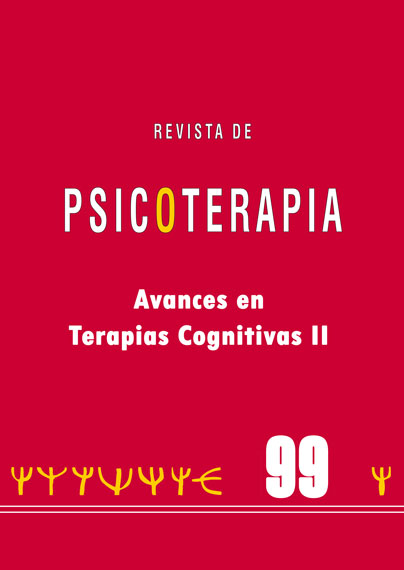
Vegazo Sánchez, E., & Saúl, L. A. (2014). Cambios en la construcción del sí mismo, estructura cognitiva y sintomatología en mujeres con trastorno distímico en terapia de grupo. Comparación con una muestra no clínica. Revista de Psicoterapia, 25(99), 49–67. https://doi.org/10.33898/rdp.v25i99.83
Número
Sección
Artículo de monográfico
Licencia
Los autores/as que publiquen en esta revista aceptan las siguientes condiciones:
- Los autores/as conservan los derechos de autor y ceden a la revista el derecho de la primera publicación, con el trabajo registrado con la Creative Commons CC-BY-NC 4.0 Internacional, que permite a terceros citar el texto y usarlo sin alterarlo y sin beneficio económico, siempre que mencionen la autoría del trabajo y la primera publicación en esta revista.
- Los autores/as pueden realizar otros acuerdos contractuales independientes y adicionales para la distribución no exclusiva de la versión del artículo publicado en esta revista (p. ej., incluirlo en un repositorio institucional o publicarlo en un libro), siempre que indiquen claramente que el trabajo se publicó por primera vez en esta revista.
- Las opiniones expresadas en los trabajos son responsabilidad única de los/as autores/as, no reflejando en ningún caso las opiniones o políticas científicas de la revista.