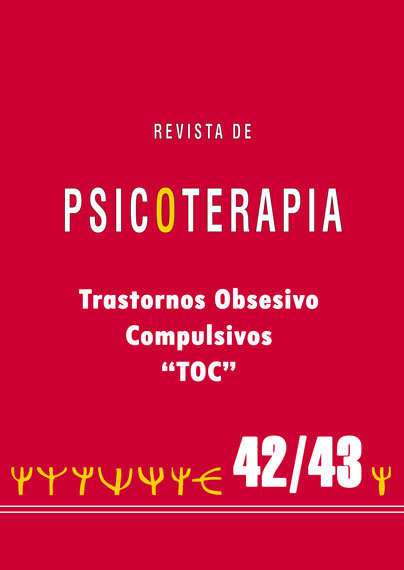
Psychopathologies of freedom: the obsession or constriction of spontaneity
DOI:
https://doi.org/10.33898/rdp.v11i42-43.518Keywords:
obsessive-compulsive disorders, socio-cognitive development, doubts, diffidence, guiltAbstract
From a socio-cognitive point of view obsessive-compulsive disorders are considered as a problem related to the formation of the epistemological criteria system. The diffidence on one’s own epistemological criteria gives rise to doubt and feelings of guilt about spontaneous impulses and emotional reactions. Therefore, one’s own way of thinking and deciding is subject to continous ruminations and doubts. As these internal criteria are not anymore a secure basis for a reasonable way to decide and act, the epistemological system looks for other external criteria, like superstitions and rituals, scientific or authoritarian principles and heteronomic rules as a guide to behave.
Downloads
Downloads
Published
How to Cite
Issue
Section
License
Authors who publish in this journal accept the following conditions:
-
Authors retain copyright and grant the journal the right of first publication, with the work registered under the Creative Commons CC-BY-NC 4.0 International license. This license allows third parties to cite the text and use it without alteration and for non-commercial purposes, provided they credit the authorship of the work and its first publication in this journal.
-
Authors may enter into other independent and additional contractual agreements for the non-exclusive distribution of the version of the article published in this journal (e.g., including it in an institutional repository or publishing it in a book), provided they clearly indicate that the work was first published in this journal.
-
The views expressed in the articles are solely the responsibility of the authors and in no case do they reflect the opinions or scientific policies of the journal.