
Impact of the Covid-19 pandemic on teacher tweeting in Spain: needs, interests, and emotional implications
DOI:
https://doi.org/10.5944/educxx1.34597Keywords:
Twitter, Covid-19, teachers, professional development, content analysisAbstract
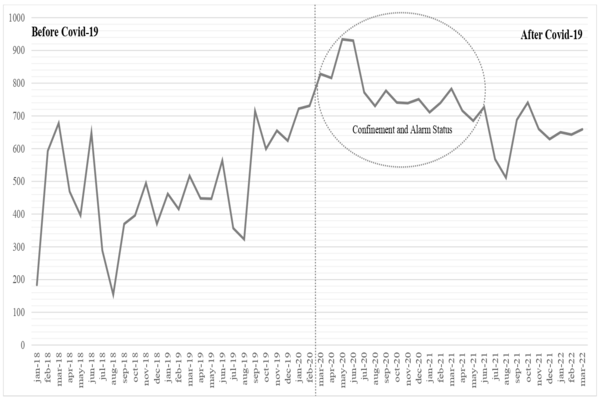
The dissemination of Covid-19 imposed the confinement of a large part of the world's population. For this reason, face-to-face classes in Spain were interrupted and did not resume until September 2021. The situation forced schools to move both teaching and communication between teachers to a digital environment, which favoured greater use of social networks. This paper conducts an exploratory study of 30751 tweets extracted from eight educational hashtags (#eduhora, #claustrovirtual, #SerProfeMola, #otraeducaciónesposible, #claustrotuitero, #profesquemolan, #orgullodocente, and #soymaestro) used by the educational community of teachers in Spain. A semantic content analysis is carried out using a mixed methodology based on public data mining and sentiment analysis. The analysis of the data provided novel information about the needs, interests and concerns, as well as the emotional implications that teachers expressed on the social network Twitter during the transition to virtual teaching. The lock-in situation was associated with increased emotional content in the tweets analysed in the sample, irrespective of the positive, negative or neutral polarity of the tweets. The results also show that teachers in Spain use social networks both for professional development and emotional support and that this trend has increased after Covid-19. The use of Twitter is linked to continuous professional development in times of particular difficulty, also in Spain, as has been the case in other countries. The findings of the study show that the historical Twitter archive is a valid resource for the analysis of teachers' feelings in longitudinal research including the Covid-19 period.
Downloads
References
Arora, A., Chakraborty, P., Bhatia, M. P. S., & Mittal, P. (2021). Role of emotion in excessive use of Twitter during COVID-19 imposed lockdown in India. Journal of Technology in Behavioral Science, 6, 370-377. https://doi.org/10.1007/s41347-020-00174-3
Beardsley, M., Albó, L., & Aragón, P. (2021). Emergency education effects on teacher abilities and motivation to use digital technologies. British Journal of Educational Technology, 52(4), 1455-1477. https://doi.org/10.1111/bjet.13101
Carpenter, J. P., & Krutka, D. G. (2015). Engagement through microblogging: educator professional development via Twitter. Professional Development in Education, 41(4), 707-728. https://doi.org/10.1080/19415257.2014.939294
Carpenter, J. P., Trust, T., Kimmons, R., & Krutka, D. G. (2021). Sharing and self-promoting: An analysis of educator tweeting at the onset of the COVID-19 pandemic. Computers and Education Open, 2, Artículo 100038. https://doi.org/10.1016/j.caeo.2021.100038
Carpenter, J., Tani, T., Morrison, S., & Keane, J. (2020). Exploring the landscape of educator professional activity on Twitter: an analysis of 16 education-related Twitter hashtags. Professional Development in Education, 48, 784-805. https://doi.org/10.1080/19415257.2020.1752287
Chen, Y., Yuan, J., You, Q., & Luo, J. (2018). Twitter sentiment analysis via bi-sense emoji embedding and attention-based LSTM. MM’18: Proceedings of the 26th ACM International Conference on Multimedia Seoul (pp. 117-125). Republic of Korea.
Del Olmo, E., & Arias, I. (2021). An empirical study with sketch engine on the syntactic-pragmatic interface for the identification of thematic structure in Spanish. Revista de Humanidades Digitales, 6, 129-150. https://doi.org/10.5944/rhd.vol.6.2021.30965
Fernández-Gavilanes, M., Juncal-Martínez, J., García-Méndez, S., Costa-Montenegro, E., & González-Castaño, F. J. (2018). Creating emoji lexica from unsupervised sentiment analysis of their descriptions. Expert Systems with Applications, 103(1), 74-91. https://doi.org/10.1016/j.eswa.2018.02.043
Firoozeh, N., Nazarenko, A., Alizon, F., & Daille, B. (2020). Keyword extraction: Issues and methods. Natural Language Engineering, 26(3), 259-291. https://doi.org/10.1017/S1351324919000457
Galvin, S., & Greenhow, C. (2020). Educational networking: A novel discipline for improved K-12 learning based on social networks. En A. Peña-Ayala (Ed.), Educational networking: A novel discipline for improved learning based on social networks (pp. 3-41). Springer.
Gao, F., & Li, L., (2017). Examining a one-hour synchronous chat in a microblogging-based professional development community. British Journal of Educational Technology, 48(2), 332-347. https://doi.org/10.1111/bjet.12384
Gee, J. P. (2017). Affinity spaces and 21st century learning. Educational Technology, 57(2), 27-31.
Gómez, M., & Journell, W. (2017). Professionality, preservice teachers, and Twitter. Journal of Technology and Teacher Education, 25(4), 377-412.
Greenhalgh, S. P., Rosenberg, J. M., & Russell, A. (2021). The influence of policy and context on teachers’ social media use. British Journal of Educational Technology, 52(5), 2020-2037. https://doi.org/10.1111/bjet.13096
Greenhalgh, S. P., Rosenberg, J. M., Willet, K. B. S., Koehler, M. J., & Akcaoglu, M. (2020). Identifying multiple learning spaces within a single teacher-focused Twitter hashtag. Computers & Education, 148, 103809. https://doi.org/10.1016/j.compedu.2020.103809
Greenhow C., Staudt Willet K. B., & Galvin S. (2021). Inquiring tweets want to know: #Edchat supports for #RemoteTeaching during COVID-19. British Journal of Educational Technology, 52(4), 1434-1454. https://doi.org/10.1111/bjet.13097
Harris, A. (2020). COVID-19–school leadership in crisis? Journal of Professional Capital and Community, 5(3/4), 321-326. https://doi.org/10.1108/JPCC-06-2020-0045
Harron, J., & Liu, S. (2022). Tweeting about teachers and COVID-19: An emotion and sentiment analysis approach. En E. Langran (Ed.), Society for Information Technology & Teacher Education International Conference (pp. 1502-1511). Association for the Advancement of Computing in Education (AACE).
Kimmons, R., & Veletsianos, R. (2018). Public internet data mining methods in instructional design, educational technology, and online learning research. TechTrends, 62, 492-500. https://doi.org/10.1007/s11528-018-0307-4
Li, X., Zhang, J., Du, Y., Zhu, J., Fan, Y., & Chen, X. (2022). A novel deep learning-based sentiment analysis method enhanced with emojis in microblog social networks. Enterprise Information Systems, 1-22. https://doi.org/10.1080/17517575.2022.2037160
Luo, T., Freeman, C., & Stefaniak, J. (2020). “Like, comment, and share” professional development through social media in higher education: A systematic review. Educational Technology Research and Development, 68(4), 1659-1683. https://doi.org/10.1007/s11423-020-09790-5
Menon, A., Klein, E. J., Kollars, K., & Kleinhenz, A. L. W. (2020). Medical students are not essential workers: examining institutional responsibility during the COVID-19 pandemic. Academic Medicine, 95(8), 1149-1151. https://doi.org/10.1097/ACM.0000000000003478
Michaels, D., & Warners, G. R. (2020). Occupational Safety and Health Administration (OSHA) and worker safety during the COVID-19 pandemic. JAMA, 324(14), 1389-1390. https://doi.org/10.1001/jama.2020.16343
Neuendorf, K A. (2017). The content analysis guidebook. SAGE.
Nochumson, T.C. (2020). Elementary schoolteachers’ use of twitter: exploring the implications of learning through online social media. Professional Development in Education, 46(2), 306-323. https://doi.org/10.1080/19415257.2019.1585382
Osorio, S., Peña, A., & Espinoza-Valdez, A. (2021). Systematic literature review of sentiment analysis in the Spanish language. Data Technologies and Applications, 55(4), 461-479. https://doi.org/10.1108/DTA-09-2020-0200
Parrish, C. W., & Martin, W. G. (2022). Cognitively demanding tasks and the associated learning opportunities within the Math Twitter Blogosphere. International Journal of Mathematical Education in Science and Technology, 53(2), 364-402. https://doi.org/10.1080/0020739X.2020.1772388
Pokhrel, S., & Chhetri, R. (2021). A literature review on impact of COVID-19 pandemic on teaching and learning. Higher Education for the Future, 8(1), 133-141. https://doi.org/10.1177/2347631120983481
Quintana-Gómez, A. (2021). Análisis de los procesos de tratamiento de información en un estudio de análisis de sentimiento utilizando la tecnología de Google. Vivat Academia. Revista de Comunicación, 154, 41-55. http://doi.org/10.15178/va.2021.154.e1336
Rehm, M., Moukarzel, S., Daly, A. J., & Del Fresno, M. (2021). Exploring online social networks of school leaders in times of COVID-19. British Journal of Educational Technology, 52(4), 1414-1433. https://doi.org/10.1111/bjet.13099
Rosell-Aguilar, F. (2018). Twitter: A professional development and community of practice tool for teachers. Journal of Interactive Media in Education, 2018(1), 6. http://doi.org/10.5334/jime.452
Sailunaz, K., & Alhajj, R. (2019). Emotion and sentiment analysis from Twitter text. Journal of Computational Science, 36, Artículo 101003. https://doi.org/10.1016/j.jocs.2019.05.009
Scott, M. (1997). PC analysis of key words – And key key words. System, 25(2), 233-245. https://doi.org/10.1016/S0346-251X(97)00011-0
Semingson, P., & Kerns, W. (2020). Categorizing and leveraging hashtag-based efforts to #Keeplearning and #Keepteaching with remote learning due to COVID-19. En Proceedings of EdMedia + Innovate Learning (pp. 115–119). Association for the Advancement of Computing in Education (AACE).
Trust, T., Carpenter, J.P., Krutka, D.G., & Kimmons, R. (2020). #RemoteTeaching & #RemoteLearning: Educator tweeting during the COVID-19 pandemic. Journal of Technology and Teacher Education, 28(2), 151-159.
Trust, T., Krutka, D. G., & Carpenter, J. P. (2016). “Together we are better”: Professional learning networks for teachers. Computers & Education, 102, 15-34. https://doi.org/10.1016/j.compedu.2016.06.007
Willet, K. B. S. (2019). Revisiting how and why educators use Twitter: Tweet types and purposes in #Edchat. Journal of Research on Technology in Education, 51, 273-289. https://doi.org/10.1080/15391523.2019.1611507
Xing, W., & Gao, F. (2018). Exploring the relationship between online discourse and commitment in Twitter professional learning communities. Computers & Education, 126, 388-398. https://doi.org/10.1016/j.compedu.2018.08.010
Zhou, J., & Ye, J. (2020). Sentiment analysis in education research: a review of journal publications. Interactive Learning Environments, 1-13. https://doi.org/10.1080/10494820.2020.1826985
Zhou, M., & Mou, H. (2022). Tracking public opinion about online education over COVID‑19 in China. Education Tech Research Dev, 70, 1083-1104. https://doi.org/10.1007/s11423-022-10080-5
Downloads
Published
How to Cite
Issue
Section
License
Copyright (c) 2023 Olga Moreno-Fernández, Alejandro Gómez-Camacho

This work is licensed under a Creative Commons Attribution-NonCommercial 4.0 International License.
Educación XX1 is published under a Creative Commons Attribution-NonCommercial 4.0 (CC BY-NC 4.0)


