Semantic Analysis from a Relational SQL Database: A Practical Example
DOI:
https://doi.org/10.5944/rhd.vol.8.2023.36571Keywords:
Database, SQL, Semantics, Eroticism, VocabularyAbstract
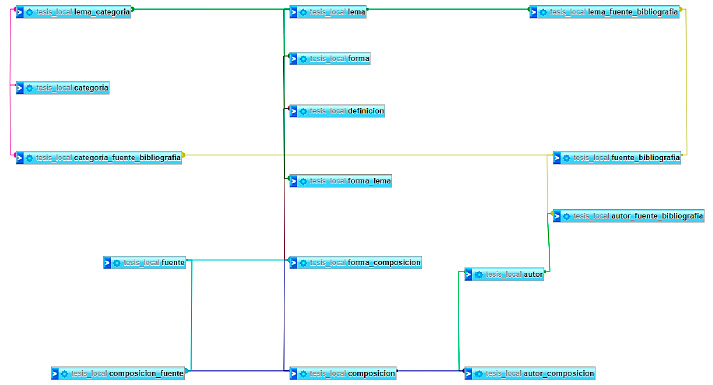
The PhD project La imaginería en la poesía erótica de los Siglos de Oro (Imagery in the erotic poetry of Golden Age) was focused on the analysis of the vocabulary of more than five hundred Spanish sexual poems from the 16th and 17th centuries. With more than 1,150 words annotated throughout the study, the writing of the work required the development of a digital SQL relational database methodology to organise and retrieve the information in an orderly structure. The purpose of this contribution is to describe in detail its creation, its structure, and its practical application in research, apart from demonstrate that SQL relational databases can be a suitable tool for the lexical-semantic analysis of literary texts. To sum up, this work aims to offer other researchers some theoretical basis for the development of similar projects in terms of theory or methodology.
Downloads
Downloads
Published
How to Cite
Issue
Section
License
Copyright (c) 2023 Álvaro Piquero Rodríguez

This work is licensed under a Creative Commons Attribution-NonCommercial 4.0 International License.
RHD provides immediate free access to its content under the principle that making research available to the public for free favors greater global knowledge sharing. RHD does not charge fees to authors for the submission or processing of articles
Users can read, download, distribute, print, search, partially reproduce or link to the texts without requesting prior permission from the editor or the author.
RHD does not charge fees to authors for the processing of works, nor fees for the publication of their articles.
RHD is free from the moment of the publication of each issue and its contents are distributed with Creative Commons license No Commercial 4.0 International , which allows the user free and open access, criteria that meet the definition of open access of the Budapest Declaration in favor of open access. This means that they can be copied, used, disseminated, transmitted and exhibited publicly, provided that the authorship and the original source of their publication are cited (magazine, editorial and URL of the work, not used for commercial purposes, mention the existence and specifications of this license of use.
The authors retain the copyright and guarantee the journal the right to be the first publication of the work. The authors are free to distribute their work published in the magazine in other media, such as an institutional repository or inclusion in a book.