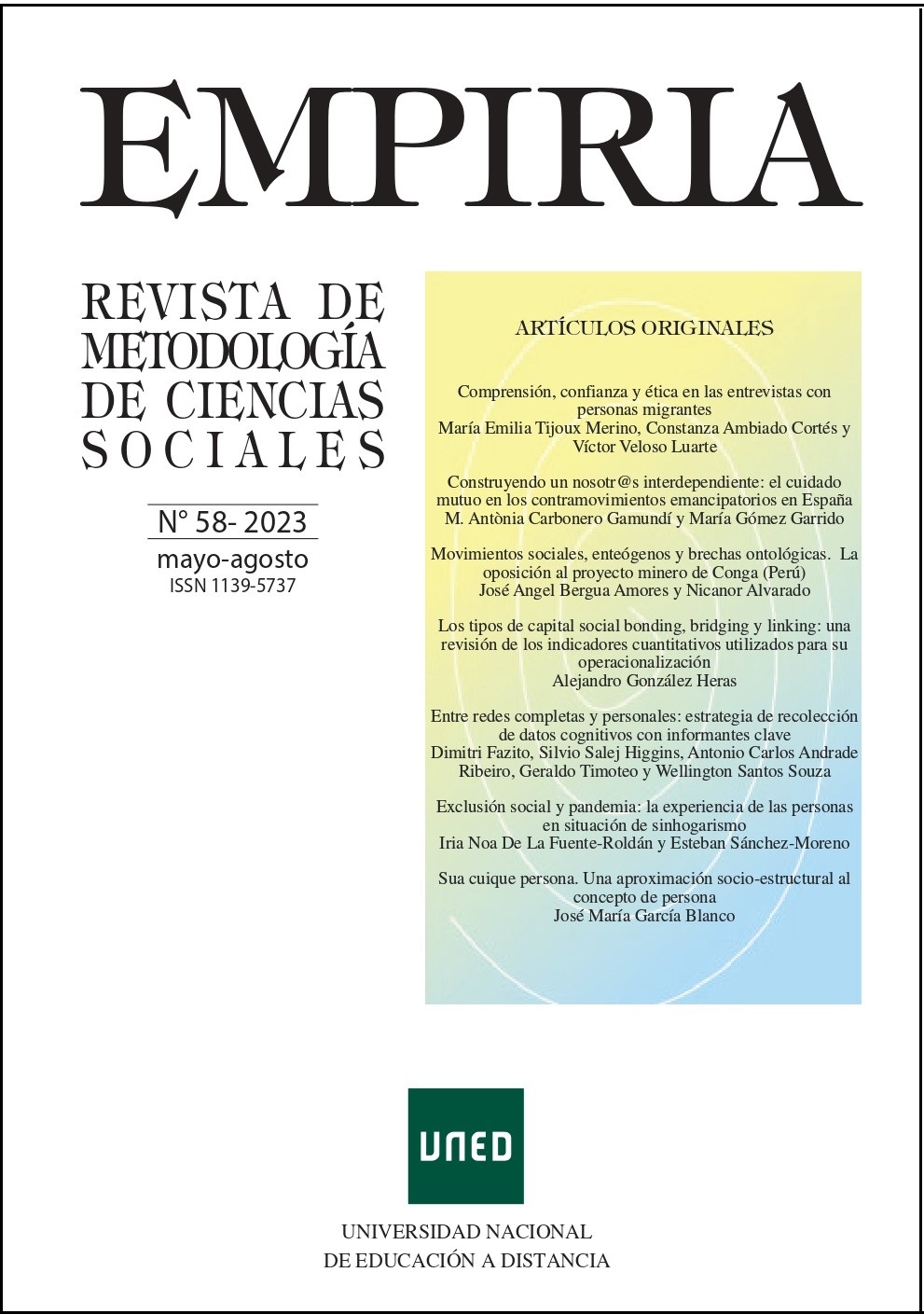
Entre redes completas y personales: estrategia de recolección de datos cognitivos con informantes clave
DOI:
https://doi.org/10.5944/empiria.58.2023.37382Palabras clave:
análisis de redes sociales, sociología relacional, redes cognitivas, líderes comunitarios, PESCARTE, social network analysis, relational sociology, cognitive networks, communitarian leadersResumen
Este trabajo propone una estrategia, denominada como Modelo de Redes Sociales Cognitivas (MRSC), para recolectar datos relacionales a partir de informantes-clave. Ofrecemos una solución para la doble problemática de, por un lado, definir los límites de una red de interaciones y, por el otro, recolectar datos de una red completa basada en la percepción de informantes que son observadores privilegiados del proceso social en estudio. El proyecto fue implementado para diagnosticar la dinámica de las relaciones comunitarias en comunidades de pesquerías tradicionales, por encomienda de un proyecto de investigación-acción (PESCARTE), en el campo de la educación ambiental, en el litoral del estado de Rio de Janeiro (Brasil). La propuesta combina técnicas de recolección de datos de redes personales y de redes completas. Los instrumentos elaborados para la recogida de datos y los procedimientos utilizados para validar la estrategia son detallados. Artículo financiado por el Proyecto de Educación Ambiental (PEA) PESCARTE, iniciativa de mitigación exigida por la Licencia Federal Ambiental conducida por el Instituto Brasilero del Medio Ambiente y de los Recursos Naturales Renovables (IBAMA).
This paper proposes a strategy, named as Model of Social Cognitive Networks, for collecting relational data from key informants. We offer a solution to the double problem of, on the one hand, defining the boundary of a network of interactions, and on the other hand, collecting data from a complete network based on the perception of informants who are privileged observers of the social process under study. The design was implemented as part of a diagnostic on the dynamics of community relations in traditional fishing communities, in the service of a research-action project (PESCARTE), in the field of environmental education, on the coast of the state of Rio de Janeiro (Brazil). The proposal combines techniques for collecting data from personal networks and complete networks. The instruments elaborated for data collection and the procedures used to validate the strategy are detailed. Article financed by the Environmental Education Project (PEA) PESCARTE, a mitigation initiative required by the Federal Environmental License conducted by the Brazilian Institute of Environment and Renewable Natural Resources (IBAMA).
Descargas
Descargas
Publicado
Cómo citar
Número
Sección
Licencia
Derechos de autor 2023 Empiria. Revista de metodología de ciencias sociales

Esta obra está bajo una licencia internacional Creative Commons Atribución-NoComercial-CompartirIgual 4.0.
Los autores que publican en esta revista están de acuerdo con los siguientes términos:a) Los autores conservan los derechos de autor y garantizan a la revista el derecho de ser la primera publicación del trabajo al igual que licenciado bajo una Licencia Internacional Creative Commons CC BY-NC-SA 4.0.
b) Se permite y se anima a los autores a difundir electrónicamente las versiones pre-print (versión antes de ser evaluada) y/o post-print (versión evaluada y aceptada para su publicación) de sus obras antes de su publicación, ya que favorece su circulación y difusión más temprana y con ello un posible aumento en su citación y alcance entre la comunidad académica.