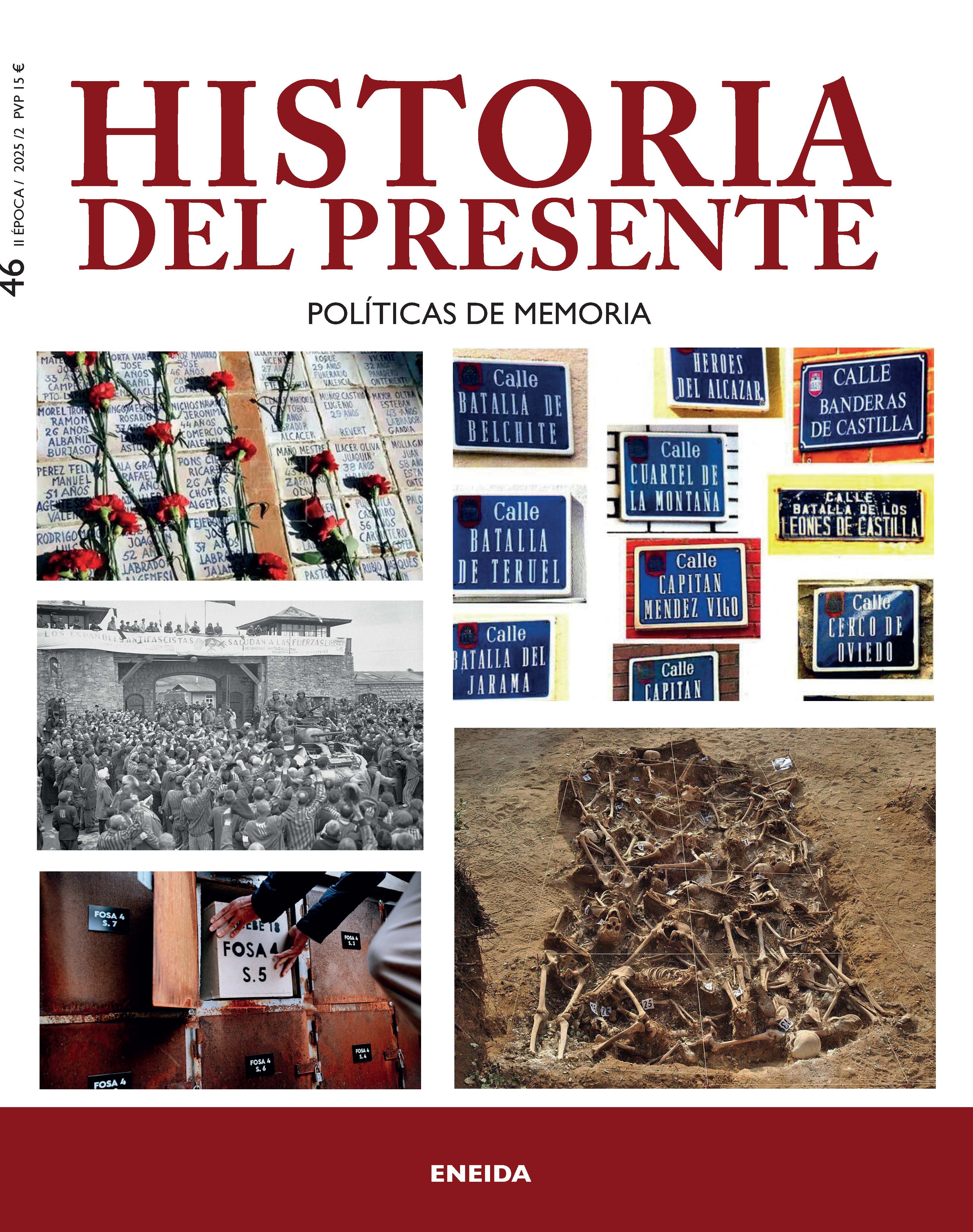
Deportation and the holocaust: recognition and remembrance of spaniards deported to nazi camps
DOI:
https://doi.org/10.5944/hdp.46.2025.47328Keywords:
Nazi camps, deportation, Spaniards, Francoism, memory, HolocaustAbstract
On February 16, 1946, the status of refugees was recognized internationally for the first time for all individuals who had been forced to leave Spain as a consequence of the Spanish Civil War and the Francoist dictatorship. Spanish survivors of Nazi concentration camps were thus kept in a legal and humanitarian limbo for more than two years after their liberation–two years in which they were forced to begin rebuilding their lives in a fragile state of abandonment. In Spain, the persistence of the Dictatorship made it impossible to recognize Spanish deportation until after 1975. This article aims to reposition the key points of the historiographical debate surrounding the deportation of Spaniards to Nazi camps and to update the frameworks through which the memory of Spanish deportation is being constructed today. It includes not only individuals who ended up in SS facilities such as Mauthausen but also women and Sephardic Jews of Spanish nationality who were led by Nazism into the machinery of extermination.
Downloads
Downloads
Published
How to Cite
Issue
Section
License
Copyright (c) 2025 Diego Martínez López

This work is licensed under a Creative Commons Attribution-NonCommercial 4.0 International License.
Esta obra está bajo una licencia internacional de uso: Atribución-NoComercial 4.0 Internacional https://creativecommons.org/licenses/by-nc/4.0/deed.es
Esta licencia permite a otros compartir el trabajo con un reconocimiento de la autoría del trabajo y de la publicación inicial en esta revista. Se pueden copiar, usar, difundir, transmitir y exponer públicamente, siempre que: i) se cite la autoría y la fuente original de su publicación (revista, editorial y URL de la obra); ii) no se usen para fines comerciales.