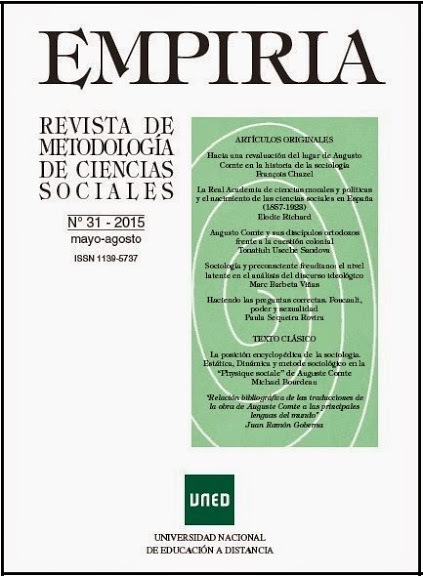
Towards a reassessment of Auguste Comte’s place in the History of sociology
DOI:
https://doi.org/10.5944/empiria.31.2015.14536Keywords:
consensus, social order, social progress, division of labour, rationalizationAbstract
Comte’s main contribution to sociology is the notion of consensus, which he took from biology. Even if he did not pay enough attention to the distinction between the empirical level and the normative one, his theory helps to understand what is wrong with the utilitarian tradition. Furthermore, although he did not succeed in specifying the mechanisms that account for consensus, many valuable insights into what could be called its ingredients can be found in his works, as shown by the way he deals with division of labour or the central place he gives to intellectual order in his general theory of order. The second part deals with the changes introduced in theSystem of Positive Policy. The last part draws a parallel between Comte’s conception of progress, as stated in the law of the three stages, and Weber’s account of the process of rationalization.
Downloads
Downloads
Published
How to Cite
Issue
Section
License
Los autores que publican en esta revista están de acuerdo con los siguientes términos:a) Los autores conservan los derechos de autor y garantizan a la revista el derecho de ser la primera publicación del trabajo al igual que licenciado bajo una Licencia Internacional Creative Commons CC BY-NC-SA 4.0.
b) Se permite y se anima a los autores a difundir electrónicamente las versiones pre-print (versión antes de ser evaluada) y/o post-print (versión evaluada y aceptada para su publicación) de sus obras antes de su publicación, ya que favorece su circulación y difusión más temprana y con ello un posible aumento en su citación y alcance entre la comunidad académica.