Estudios e investigaciones
Artificial intelligence and collective intelligence in digital higher education: a quasi-experimental study using the Kampal platform
Inteligencia artificial e inteligencia colectiva en la educación superior digital: estudio cuasi-experimental con la plataforma Kampal
 Alicia Martínez-De la muela
Juan Pablo Ruiz-Fuentes
José Luis González-Geraldo
Alicia Martínez-De la muela
Juan Pablo Ruiz-Fuentes
José Luis González-Geraldo
Artificial intelligence and collective intelligence in digital higher education: a quasi-experimental study using the Kampal platform
RIED-Revista Iberoamericana de Educación a Distancia, vol. 29, núm. 1, pp. 29-51, 2026
Asociación Iberoamericana de Educación Superior a Distancia

Esta obra está bajo una Licencia Creative Commons Atribución-NoComercial 4.0 Internacional.
How to cite: Martínez-De la muela, A., Ruiz-Fuentes, J. P., &
González-Geraldo, J. L. (2026). Artificial intelligence and collective intelligence in digital higher
education: a quasi-experimental study using the Kampal platform [Inteligencia artificial e inteligencia
colectiva en la educación superior digital: estudio cuasi-experimental con la plataforma Kampal]. RIED-Revista Iberoamericana de Educación a Distancia, 29(1), 29-51. https://doi.org/10.5944/ried.45560
Abstract: The emergence of Artificial Intelligence (AI) in higher education poses the challenge of integrating personalized learning with collaborative learning. Collective intelligence is presented in this study as a tool that allows both approaches to be articulated, transforming individual contributions into shared knowledge through AI-mediated technologies. Within this framework, the perception of the Kampal platform as a learning environment that simultaneously promotes student autonomy and collective knowledge construction is analyzed. A pretest-posttest quasi-experimental design was used with an initial sample of 399 digital distance higher education students and a final matched sample of 25 cases. Three dimensions were evaluated through a structured questionnaire: familiarity with the tool, perception of its effectiveness, and expectations of use or future willingness to use similar technologies. The results show a significant increase in familiarity with Kampal and willingness to use collective intelligence tools in the future, although no significant changes were found in expectations or perceptions of immediate effectiveness. Factor analysis revealed two main dimensions: familiarity and effectiveness/expectations. The findings suggest that these tools promote a favorable attitude toward their future use, although without significant changes in perceived effectiveness. This highlights the need for intentional teacher mediation. When properly supervised, AI empowers hybrid environments that integrate personalization and collaboration, where collective intelligence operates as a nexus, facilitating complex dynamics such as swarm intelligence in higher education.
Keywords: artificial intelligence, AI-mediated learning, higher education, collective intelligence, distance education, Kampal.
Resumen: La irrupción de la Inteligencia Artificial (IA) en educación superior plantea el desafío de integrar el aprendizaje personalizado con aprendizaje colaborativo. La inteligencia colectiva se sitúa en este estudio como una herramienta que permite articular ambos enfoques, al transformar aportaciones individuales en conocimiento compartido mediante tecnologías mediadas por IA. En este marco, se analiza la percepción del uso de la plataforma Kampal como entorno de aprendizaje que favorece simultáneamente la autonomía del estudiante y la construcción colectiva del conocimiento. Se empleó un diseño cuasi-experimental pretest-postest con una muestra inicial de 399 estudiantes de educación superior a distancia digital y una muestra final emparejada de 25 casos coincidentes. A través de un cuestionario estructurado, se evaluaron tres dimensiones: familiaridad con la herramienta, percepción de eficacia de esta y expectativas de uso o disposición futura a utilizar tecnologías similares. Los resultados muestran un incremento significativo en la familiaridad con Kampal y en la disposición a emplear herramientas de inteligencia colectiva en el futuro, aunque no se hallaron cambios significativos en las expectativas ni en la percepción de eficacia inmediata. El análisis factorial reveló dos dimensiones principales: familiaridad y eficacia/expectativas. Los hallazgos sugieren que estas herramientas fomentan una actitud favorable hacia su uso futuro, aunque sin cambios significativos en la percepción de eficacia. Esto resalta la necesidad de una mediación docente intencionada. Supervisada adecuadamente, la IA potencia entornos híbridos que integran personalización y colaboración, donde la inteligencia colectiva opera como nexo, facilitando dinámicas complejas como la inteligencia de enjambre en educación superior.
Palabras clave: inteligencia artificial, aprendizaje mediado por IA, educación superior, inteligencia colectiva, educación a distancia, Kampal.
INTRODUCTION
Reference to Artificial Intelligence (AI), especially within the educational field, has become risky but also significantly synonymous with ChatGPT or, failing that, with other Large Language Models (LLM) such as Copilot, Gemini, or Claude, to mention some of the main LLMs, all of them proprietary, although there are some open source alternatives. However, as becomes evident, as soon as we observe the evolution of the use and implementation not only of AI, but also of Information and Communication Technologies (ICT) in education and especially in distance education (Bozkurt, 2023), we realize that—without having to resign ourselves to the merely generative text (as also occurred before with other technological advances, for example, MOOC/NOOC)—AI requires rethinking current educational models both urgently and profoundly as pointed out by García-Aretio (UNED, 2025).
Strictly speaking, the concept of AI has been with us for almost seventy years, having evolved irregularly—known as the winters of AI—to the present day (Russell & Norvig, 2020). Without detailing the different subfields that comprise it (machine learning, for example), as well as the different AIs that exist depending on their specificity (weak-strong AI), we can comprehend that under the concept of AI, we refer to the use of algorithms that allow performing and streamlining intelligent work normally associated with human beings. In this sense, it should also be noted that, especially in education, it is not so much a matter of seeing what can be done by us through AI substitution but rather what AI can do for us— provision, and even with us—collaboration.
It is also appropriate to consider the roadmap proposed by OpenAI towards artificial general intelligence, which establishes five progressive levels (Table 1) that guide the current and future development of these technologies (Duenas & Ruiz, 2024).
OpenAI's Five-Level Framework for AI Development
| Level | Name | Key features |
| 1 | Chatbots | Conversational Language Skills |
| 2 | Reasoning [skills] | Problem-solving at a human level |
| 3 | Agents | Autonomous action |
| 4 | Innovative [actions] | Supporting invention and creativity |
| 5 | Organizations | Complex organizational management |
This line addresses the potential of AI in digital distance education, going beyond LLM or Level 1, while, as we will see, reflecting on some of the challenges we currently face, whether we like it or not. In this sense, the European Union Regulation on Artificial Intelligence (European Union, 2024), commonly referred to as the "AI Act," must be a key piece that establishes ethical and responsible guidelines and a roadmap for these new platforms to effectively catalyze educational improvement, rather than simply delegate responsibilities. Obviously, such responsibilities must always remain not only in human hands but also in expert hands, especially in sensitive areas such as justice, health, and, in the case at hand, education— particularly higher education.
For these reasons, platforms such as the one we are dealing with, focused on the use of AI for a collective and pedagogical purpose, would allow us to act as an extension of group memory, optimize collective attention, strengthen collective reasoning, carry out tutoring on a personalized scale and, consequently and in parallel, save time on routine tasks (Riedl & De Cremer, 2025). Of course, as these and other authors point out, these benefits are not without risks: biases, dependency, digital gaps, resistance to change, etc. Among them, as we will see in more detail in the final part of the article, is the potential reduction of intellectual diversity (Riedl & Bogert, 2024). In contrast, collaborative work in virtual environments enhances the development of intrinsic motivation and strengthens self-esteem by reducing feelings of isolation and allowing each participant to perceive their contribution as essential to the collective achievement (Marrón Luna, 2021).
This article is framed within this critical need, with a particular focus on a key issue in the current pedagogical debate: how to integrate personalized learning with collaborative learning in AI-mediated environments, including a balance between AI-mediated interaction and the human factor in learning contexts and the collective construction of knowledge (Msambwa et al., 2025). While current applications tend to prioritize individualized learning through conversational systems, there is still little development of tools that promote collective processes of knowledge construction. Despite the exponential advancement of everything related to AI, this scarcity extends to the lack of evidence in the literature regarding platforms that go beyond language generation models, particularly concerning the concept of AI-assisted collective intelligence.
Collective intelligence is therefore presented in this study as a tool that supports both personalized learning, through the review of contributions and the monitoring of individual behavior, and collective learning, revealing a potential to share knowledge and reach joint results through a digital platform. Kampal Collective Learning (KCL) is a collective intelligence platform developed by Kampal Data Solutions, a spin-off company from the University of Zaragoza. Its main objective is to facilitate collaborative problem-solving by combining individual and collective contributions in real time. The platform operates through structured phases where participants can propose, review, and modify ideas, promoting dynamic and collaborative learning.
Before continuing, it is essential not only to point out that Kampal is not a chatbot, but instead, the use of AI is far removed from the control and knowledge of the users themselves and, in this case, also its beneficiaries. In other words, neither teachers nor students are aware of what and how the algorithms that underlie Kampal work, and which make up the work groups and networks on which this Collective Intelligence is built. We are, therefore, dealing with a platform that considers AI from the prism of Big Data (BD) and Machine Learning (ML), and which, as we will also discuss in the final part of these lines, among other issues, faces the elusive traceability of AI models typified as "black box” models. Hence, to complement and differentiate our work from the avalanche of studies on the relationship between AI (LLM) and education, and to explore the extent to which other platforms are accepted, their impact, and potential use in our educational programs, we selected the Kampal tool (https://ic.kampal.com/?locale=es). The ultimate objective of Kampal is to enable and enhance the use of Collective Intelligence (CI, also known as Thinkhub) for collaborative problem-solving through the use of AI.
Although the literature on the use of Kampal is not very extensive, we are dealing with a medium that is certainly adequate for mass education and whose benefits go beyond the strictly academic (Gonzalo et al., 2023) or merely informational, thus addressing moral dilemmas and not only knowledge (Bautista-Alcaine et al., 2025). The genesis of some of this knowledge stems from the deficient implementation of AI, such as the prevalence of fake news (Cebollero-Salinas et al., 2024). In any case, as we observe in the methodology of these same investigations, it is suitable for quality education, and therefore higher education, which may well be distance education.
Collective intelligence in the context of digital distance higher education
As García Aretio (2020) points out, distance education has undergone a semantic and functional transformation, evolving into more complex models (face-to-face, distance, or mixed/combined), which can be integrated into the concept of Digital Distance Education (DDE) in the field of higher education. In this context, far from being limited to an individualistic learning model, DDE increasingly directs its efforts towards strengthening personalized learning within the educational process. After a systematic review of the literature, Bayly-Castaneda et al. (2024) note that AI is primarily focused on the field of higher education, where the use of adaptive learning technologies for developing personalized learning paths is predominant. This paradigm aims to integrate the personalization of learning with the construction of a community of knowledge, in which all its members share responsibility for the generation and consolidation of knowledge. This view is reinforced by the idea of using visualization tools to facilitate the interpretation of the contributions in collective intelligence environments (Ullmann et al., 2019).
We highlight the contribution of Fidalgo-Blanco et al. (2017), who developed a theoretical-practical model of collective intelligence in the presential university classroom, based on the management of knowledge generated by students through a private social network. Although their experience takes place in a face-to-face environment, the underlying principles and cooperative approach based on the collective's individual intelligence are extended to the use of platforms that automate and scale these interactions through AI. According to the analysis by Zawacki-Richter et al. (2019), it is noted that the use of this technology in most higher education applications developed to date has relegated teachers to a peripheral role. According to these authors, AI-based solutions focus on automatic content design, outcome prediction, or performance monitoring, but they neglect the pedagogical role of the educator as a mediator of learning, designer of meaningful contexts, and promoter of critical and collective thinking.
Digital education should integrate this approach with the collective construction of knowledge. In this sense, tools like Kampal represent a hybrid proposal of notable pedagogical value because they allow combining the individual traceability of the learning process with active participation in experiences of collective intelligence. The algorithms used allow student contributions to be organized according to their relative popularity, and they also make the processes of editing, copying, and transforming ideas visible, thus creating an environment where the individual and the collective feed each other. In pedagogical terms, collective intelligence prevents personalized learning from being limited to the adaptation of content or rhythms. Instead, it allows personalized learning to expand towards the personalization of cognitive contributions, which can then be put at the service of the group. In turn, collaborative learning is enriched with a broader and more diverse base, where each student participates not only as a receiver but as a producer and evaluator of shared knowledge. This dynamic is strengthened by the traceability offered by the tool, allowing the teacher to monitor participation, detect patterns of interaction, and make more informed training decisions.
In this way, collective intelligence is configured as a meeting point between the singularity of individual thought and the transformative power of group dialogue, which goes through a series of phases that allow editing, eliminating, or copying ideas until a collective response is achieved. Its implementation, mediated by AI, not only optimizes teaching-learning processes but also promotes a more inclusive, reflective pedagogical culture committed to the construction of situated and shared knowledge. This technological solution, specifically designed to promote collective intelligence processes, enables the students' individual contributions—which reflect their own learning styles, previous knowledge, and levels of development—to be shared in a digital environment that fosters the analysis, synthesis, and collaborative evaluation of these ideas. Using analysis algorithms based on AI (mainly BD and ML) and data visualization, the platform generates indicators such as the three or ten most popular responses, facilitating the identification of emerging consensuses and the most significant contributions according to the majority's preference.
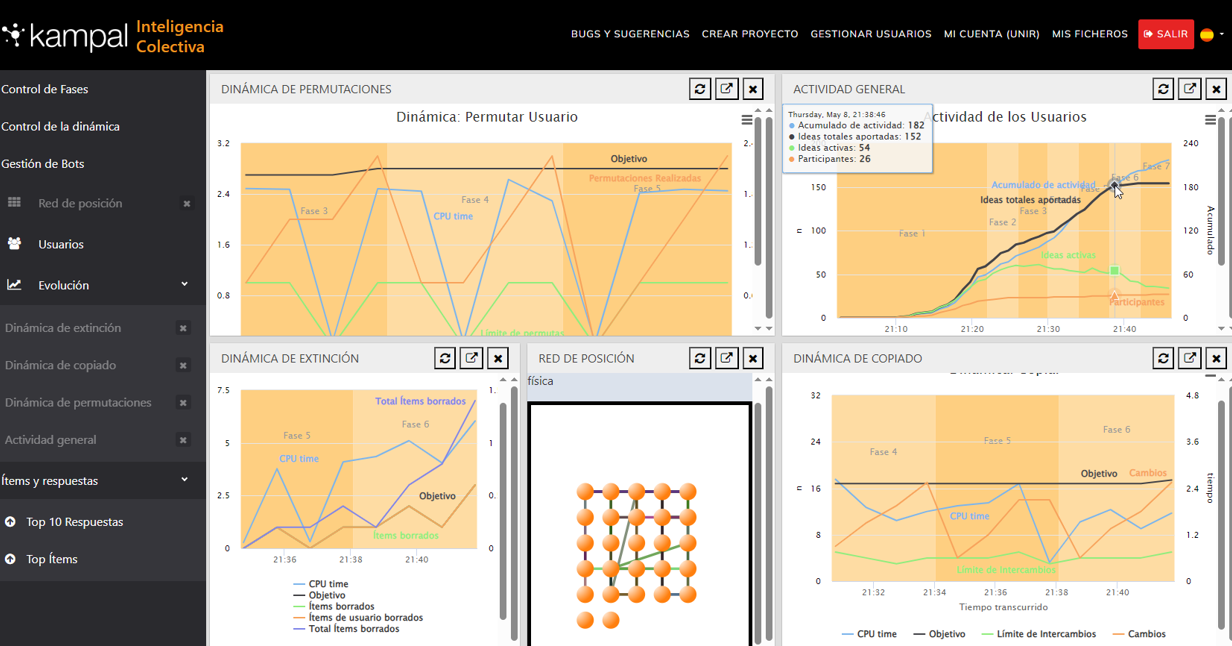
Kampal is, therefore, an online tool that, through a process ordered by AI, helps the teacher to monitor individual behavior in the development of ideas in the students’ collective learning groups. According to the Kampal Data Solutions company, "the platform generates an internal dynamic using Artificial Intelligence, Complex Networks, etc., to energize the interaction between the participants and guarantee the survival of the most popular responses among all those emitted" (p. 5). Figure 1 presents an example of the different dynamics during the development of the activity, where collective intelligence is empirically shown through the convergence of individual responses towards a shared synthesis.
Visualization panel of dynamic and structural metrics of the Kampal platform in real time during a collective intelligence activity
Source: Prepared by the authors.
One of this tool’s underlying benefits is that "all individuals start from equity, and each idea should be valued for its content and not for who proposes it” (Bautista-Alcaine et al., 2025, p. 2). For their part, Orejudo et al. (2022) conducted an investigation involving 900 students, demonstrating the potential of collective intelligence to enhance group collaboration and how a high-quality response is guided through the phases.
Taken together, this evidence indicates that collective intelligence, mediated by technological tools such as Kampal, represents a qualitative evolution in the teaching-learning models of digital distance higher education. Not only does it respond to the increasing demands for personalization in virtual environments, but it also enables the incorporation of deep collaboration dynamics in a structured and measurable way, conceiving of the student as an active co-creator of knowledge. Collective intelligence emerges as a legitimate approach to rebalancing the social dimension of online learning, valuing both individual contributions and the emerging synergies of groups. In this sense, its implementation constitutes not only a methodological innovation but also a response to the pedagogical, technological, and ethical challenges posed by digital higher education in the twenty-first century.
This study analyzes the impact of Kampal use on the perception of collaborative learning in digital higher education, assessing variations in familiarity, perceived efficacy, and expectations about AI-mediated technologies.
METHODOLOGY
In accordance with the nature of the problem, a quantitative quasi-experimental design (Hernández Sampieri et al., 2010) was considered adequate, as it offers greater possibilities of generalization to real everyday contexts than experimental designs. At the same time, it is the most viable and ethical alternative, providing relevant information on the impact of a treatment or the evolution of a change process. For this purpose, a pre-post-test measurement was performed in a single group, using the Kampal collective intelligence tool as the intervention. This methodological structure enables the observation of effects in a non-randomized sample, allowing for comparisons of results obtained before and after treatment.
The students of the "Technologies for educational innovation" subject in the Official Master's Degree in Educational Innovation at the International University of La Rioja (UNIR) participated in solving a collaborative activity within an academic forum. The collective intelligence tool Kampal was used to analyze and synthesize the students' responses to a practical case concerning the ethical use of AI in the classroom. The first intervention consisted of responding to three key questions, which were addressed synchronously and collectively through Kampal. The collaborative forum activity took place over three weeks, allowing for scaled and reflective participation. Kampal was used for one hour, during which the students underwent seven phases generated by automatic dynamics to promote collaboration. They could analyze their “neighbor’s” information, modify their own responses, and/or copy the responses of one of their classmates. Kampal's objective is to generate a collective response based on the students' contributions in the first intervention, which served as a basis for subsequent reflections and improvements. Specifically, the third intervention had a direct relationship with the contents that emerged from the collective intelligence in the virtual face-to-face session. Given the formative nature of the activity, integrated into the curricular development of the subject and linked to a formative assessment, it was not possible to establish a control group. This constitutes a methodological limitation to be considered.
In this study, three essential conceptual dimensions were addressed: familiarity, efficacy, and expectations of use. Familiarity refers to intuitive recognition and perceived ease of use, which are determining factors in the initial acceptance of AI platforms in collaborative university environments (Chan & Hu, 2023). Effectiveness refers to the quality and pedagogical relevance of collaborative contributions facilitated by AI (Wang et al., 2025). Expectations of use refer to the future willingness to employ AI technologies in academic activities, aligning with technology adoption models that link positive experiences with a greater intent to use (Khlaif et al., 2024).
Based on the quasi-experimental pretest-posttest approach with a single group, three research hypotheses were formulated that guided the analysis of the effects of the use of Kampal. We expected:
- A significant increase in students' familiarity with collective intelligence technologies and with the Kampal platform itself compared to their level before the intervention.
- A significant improvement in the perception of the effectiveness of collaborative work and the ability to relate and improve individual contributions after using Kampal, compared to previous perceptions.
- An increase in students' future willingness to employ collective intelligence-based tools in academic settings after participation in Kampal-mediated collaborative activities.
These hypotheses were tested through non-parametric statistical analyses, which are appropriate for the type of data and the structure of the sample, to assess the perceived impact of the tool in a digital distance higher education environment.
Context
The research was conducted at the International University of La Rioja (UNIR), which provides 100% online higher education on an official basis. Law 3/2008, of October 13, legally recognized the International University of La Rioja. The Parliament of the autonomous community thereby approved its legal personality in the form of a public limited company, characterized by distance learning, based on ICT, without a physical campus, with synchronous and asynchronous classes (UNIR, 2024). It offers university education and provides public service in higher education through research, teaching, and scholarly study.
Population
The sample for this study (n = 399) comprises students of the Master's Degree in Educational Innovation at UNIR enrolled in the subject "Technology for Educational Innovation”. The invitation guaranteed the confidentiality of the data, leaving a total of n = 152 subjects at pre-test and n = 77 subjects at post-test. After filtering the data, the final sample was n = 147 at pre-test and n = 62 at post-test. When analyzing the university students' perception of the use of the Kampal collective intelligence application between pre-test and post-test, a sufficiently matched sample was identified concerning the proposed objectives (n = 25). The loss of continuity in the anonymous identifiers assigned to each student, together with the voluntary nature and participation in the live session of the tool, may have influenced this final sample.
In all measurements, most of the participants identified as women, and this trend was maintained both at pre-test (65.31%) and post-test (66.13%), and in the matched cases (60%). Male representation was lower at all times, and non-binary or undeclared categories were very scarce. Regarding the distribution by country (Table 2), most of the sample came from Colombia, both at pre-test (76.87%) and post-test (70.97%), and in the matched cases (64%). Although other countries, such as Spain, Ecuador, and Argentina, had a lower presence, a slight relative increase in their representation was observed at post-test and in the matched cases. The participation of other countries was marginal, and some, like Chile or the United States, only appeared in one of the phases or were absent in the matched data.
Distribution of the sample according to country
| Country | Pre-test | Post-test | Matched Pre-Post |
|||
| n | % | n | % | n | % | |
| Colombia | 113 | 76.87 | 44 | 70.97 | 16 | 64.00 |
| Spain | 9 | 6,12 | 7 | 11.29 | 4 | 16.00 |
| Ecuador | 5 | 3.40 | 5 | 8.06 | 2 | 8.00 |
| Peru | 5 | 3.40 | 3 | 4.84 | 0 | 0.00 |
| Chile | 5 | 3.40 | 0 | 0.00 | 0 | 0.00 |
| Argentina | 3 | 2.04 | 2 | 3.23 | 2 | 8.00 |
| Rest of Latin America | 2 | 1.36 | 1 | 1.61 | 1 | 4.00 |
| Other | 4 | 2.72 | 0 | 0.00 | 0 | 0.00 |
| United States | 1 | 0.68 | 0 | 0.00 | 0 | 0.00 |
| TOTAL | 147 | 100 | 62 | 100 | 25 | 100 |
Regarding teaching experience (Table 3), the profile with more than 10 years of experience predominated, both at pre-test (42.18%) and post-test (37.10%), and in the matched cases (40%). However, a higher relative representation was observed of teachers with less than 3 years of experience at post-test (27.42%) and in the matched cases (24%).
Distribution of the sample according to level of teaching experience
| Category | Pre-test | Post-test | Matched Pre-Post |
|||
| n | % | n | % | n | % | |
| More than 10 years | 62 | 42.18 | 23 | 37,10 % | 10 | 40,00 % |
| 6 to 10 years | 34 | 23.13 | 10 | 16,13 % | 6 | 24,00 % |
| Less than 3 years | 29 | 19.73 | 17 | 27,42 % | 6 | 24,00 % |
| 3 to 5 years | 16 | 10.88 | 9 | 14,52 % | 2 | 8,00 % |
| No experience | 6 | 4.08 | 3 | 4,84 % | 1 | 4,00 % |
| TOTAL | 147 | 100.00 | 62 | 100,00 % | 25 | 100,00 % |
Instrument
The assessment instrument "Questionnaire to analyze university students’ perception of the use of the Kampal Collective Intelligence application" (CPIC) was administered. The questionnaire had been previously validated by a committee of three experts with diverse academic backgrounds, all of whom were specialists in pedagogy, before the intervention began. The data were migrated to the Microsoft Forms application to facilitate their distribution and collection. The results of the Aiken V-index were higher than .7 in all the items except for three, and in no case less than .6, thus obtaining adequate content validity (Penfield & Giacobbi, 2004).
The questionnaire’s first item is an informed consent form, in compliance with the regulations for the approval of research by the Research Ethics Committee (Ref. 037/2025) of the International University of La Rioja (UNIR), following all the protocols in terms of confidentiality and anonymity (UNIR, 2025).
The instrument consists of four blocks:
- Block I: Biographical information. Comprising Items 2 to 5, it includes questions to obtain personal identity information: sex (male, female, none of the above, I prefer not to answer), country (Spain, Colombia, Ecuador, Peru, Mexico, Argentina, Chile, United States, the rest of Latin America, others), and level of teaching experience in years (no experience, less than 3 years, 3 to 5 years, 6 to 10 years, more than 10 years).
- Block II: Familiarity. It includes Items 6 to 8, which aim to assess the students' familiarity with collective intelligence applications, specifically Kampal.
- Block III: Efficiency. It integrates Items 9 to 12, aimed at assessing the perception of the effectiveness of collective intelligence among students.
- Block IV: Use expectations. It presents Items 12 to 14, which obtain usability expectations in terms of learning, collaboration, and availability of collective intelligence applications.
Table 4 shows the questions in each block by item:
CPIC blocks, items, and questions
| Items and questions | |
|
Block I: Biographical Information |
1. Personal ID. 2. Sex. 3. Country. 4. Indicate level of experience in years. |
|
Block II: Familiarity |
5. Do you think that the level of use of the application of Artificial Intelligence
has increased after the experience? 6. Do you think that the level of use of collective intelligence applications has increased after the experience? 7. Do you think the level of use with the Kampal app has increased after the experience? |
|
Block III: Efficacy |
8. To what extent do you think the use of a Collective Intelligence application
could improve the quality of collaborative work? 9. Has the use of the Collective Intelligence application helped you to change, improve, or discard your initial answers to the questions posed in the activity? 10. Do you think that the responses arising from Collective Intelligence have helped you relate contributions to the forum? |
|
Block IV: Use expectations |
11. I think this Collective Intelligence application will help me in my learning
process. 12. I think this Collective Intelligence application will help me in terms of collaboration. 13. Would you be willing to use collective intelligence applications in future academic activities? |
After the respondents completed the questionnaire, the data were imported into the statistical package for the social sciences, IBM SPSS Statistics 25, to obtain the appropriate psychometric properties and to perform the relevant statistical analyses.
ANALYSIS AND RESULTS
Within the framework of incorporating collaborative technologies into the educational field, a descriptive statistical analysis was conducted, along with an examination of the psychometric properties and perceived usefulness of a collective intelligence tool. Using a quantitative approach, internal consistency tests, exploratory factor analysis, and non-parametric techniques were applied to assess the instrument's adequacy in capturing significant perceptions. The results obtained provide relevant evidence regarding the validity, reliability, and perceived usefulness of a collective intelligence tool applied in the educational setting.
Descriptive statistical analysis
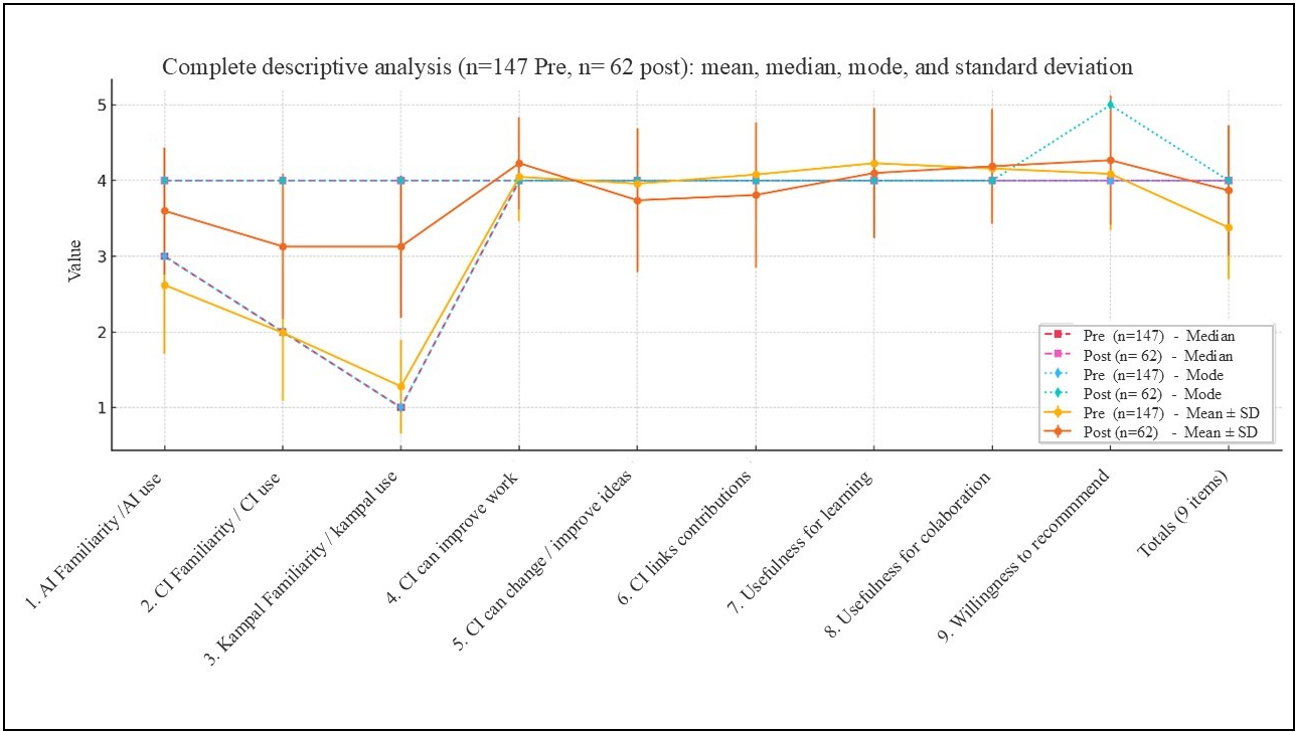
From pre-test to post-test, there was clear progress in the adoption of the technologies (Figure 2): mean familiarity with artificial intelligence registered an increase of 2.62 to 3.74, for collective intelligence of 1.99 to 3.60, and for Kampal of 1.28 to 3.13. The belief that collective intelligence improves collaborative work also increased from 4.05 to 4.23, while expectations about its impact on ideas and the relation of contributions decreased slightly. The ratings of usefulness for learning and collaboration remained around 4.10 and 4.20, and the willingness to recommend the tool increased from 4.09 to 4.27, changing the mode from 4 to 5. Overall, the global mean of the nine items increased from 3.38 to 3.87, with standard deviations always less than 1.
Results of descriptive statistical analysis
Source: Prepared by the authors.
Overall, there was a global improvement in familiarity with Artificial Intelligence, Collective Intelligence, and the Kampal tool. Ratings of its usefulness and willingness to recommend it also increased slightly, while perceptions of its contribution to learning and collaboration remained stable. The responses showed consistency, with low variability in scores.
Inferential statistical analysis
Following Hair et al. (2019), the instrument demonstrated high internal consistency (α = .856), which supports its reliability and suitability in capturing participants' perceptions of the analyzed tool.
For the exploratory factor analysis, orthogonal Varimax rotation was used with Items 5 to 13. Sampling adequacy was moderate (KMO = .764), but acceptable for the procedure (Field, 2009), supported by Bartlett’s significant sphericity test (p < .000). The analysis identified two factors, which explained 59.82% of the construct variability. The first factor explained 39.72% and the second explained 20.10%. In contrast, for the subsequent interpretation of the factors, we employed the initial rotated component matrix (Table 5). This matrix determined different factorial loadings for the selection of the items included in each of the two factors and provided the magnitude of the correlation between the item and the factors, ordered by size and eliminating low coefficients with an absolute value below .400, based on the suggestion of Stevens (2002).
Rotated component matrix
| Component | ||
| Familiarity AI | .738 | |
| Familiarity Collective Intelligence | .862 | |
| Familiarity Kampal Intelligence | .663 | |
| To what extent do you think that the use of a Collective Intelligence application can improve the quality of collaborative work? | .828 | |
| To what extent do you think Collective Intelligence can help change, improve, or discard your initial idea of certain content? | .754 | |
| To what extent do you think that the responses that emerge from a collective intelligence will help you relate contributions and improve them? | .762 | |
| I think this Collective Intelligence application will help me in my learning process. | .795 | |
| I think this Collective Intelligence application will help me in terms of collaboration. | .815 | |
| Would you be willing to use collective intelligence applications in future academic activities? | .621 | |
The name of the factors found was determined by the elements that constituted it and the content to which each of them referred, finally called: Factor 1, Familiarity, and Factor 2, Efficacy/Expectations. Although the factorial results were optimal, it is worth noting that there may be some conceptual overlap between the two factors, as an increase in familiarity could influence perceptions of efficacy and use expectations.
The evaluation of the normality of the data, by means of the Kolmogórov-Smirnov and Shapiro-Wilk indices, showed significant deviations from the normal distribution in all variables (p < .05). This justified the use of non-parametric tests, which are more appropriate and robust for asymmetric distributions or when there are outliers.
Comparisons by sex were then made using the Mann-Whitney U-test (Table 6). The results yielded no statistically significant differences between men and women in any of the dimensions evaluated.
Test results of the Mann-Whitney U-test by sex
|
pre_ familiarity_ Factor1 |
post_ familiarity_ Factor1 /span> |
pre_ effectiveness/ expectations Factor2 |
post_ effectiveness/ expectations Factor2 |
|
| Mann-Whitney U-test | 53.000 | 67.000 | 51.000 | 52.500 |
| Wilcoxon W | 173.000 | 187.000 | 171.000 | 172.500 |
| Z | -1.253 | -.459 | -1.354 | -1.262 |
| Sig.(2-tailed) | .210 | .646 | .176 | .207 |
| Exact. Sig. (2-tailed) | .238 | .683 | .196 | .216 |
Subsequently, the differences according to teaching experience were explored using the Kruskal-Wallis test. The results (Table 7) yielded no statistically significant differences, indicating a positive transversal assessment of the tool, regardless of the level of professional experience.
Test results of the Kruskal-Wallis test according to teaching experience
|
pre_ familiarity_ Factor1 |
post_ familiarity_ Factor1 |
pre_ effectiveness/ expectations Factor2 |
post_ effectiveness/ expectations Factor2 |
|
| Kruskal-Wallis H | 1.281 | 3.655 | 1.799 | .524 |
| df | 4 | 4 | 4 | 4 |
| Sig.(2-tailed) | .865 | .455 | .773 | .971 |
Finally, a pre-post analysis was carried out using the Wilcoxon signed-rank test. The results revealed statistically significant improvements in familiarity with the tool (z = -4.32, p < .001, r = .68) and future willingness to use collective intelligence-based technologies (z = -4.26, p < .001, r = .67), both with large effect sizes. In contrast, no significant changes were observed in expectations about outcomes (z = -0.29, p = .770, r = .05) or the perception of self-efficacy (z = -0.75, p = .453, r = .12).
DISCUSSION AND CONCLUSIONS
Currently, AI in education has been predominantly limited to applications based on LLMs, such as ChatGPT, which operate according to the levels delimited by OpenAI, at a conversational level 1. This narrow focus has raised concerns about its impact on assessment and learning processes in higher education (Consuegra-Fernández et al., 2024). In this study, we have addressed a second higher level of processing thanks to the collective intelligence approach proposed by Kampal, which transcends simple conversational interaction. In contrast, the work is performed at Level 3 (agents) because IA makes structural decisions on behalf of the user (formation of groups, selection of ideas, etc.), although without full autonomy. However, the most significant convergence is located at Levels 4 (innovative) and 5 (organizations), because the Kampal platform enables emerging collaborative solutions, complex and self-organized dynamics, and structures that learn and evolve.
Although the study started with a defined population (399 students), the progressive reduction to a matching sample of 25 subjects in the pretest-posttest measurement introduces some limitations concerning external validity. However, as pointed out by Creswell and Creswell (2017), this type of exploratory study with non-probabilistic samples provides relevant information in real contexts, especially when seeking to evaluate the acceptance and perception of new educational technologies. The final sample, which had a predominance of women, high geographical representation from Colombia and high teaching experience offer a relevant perspective within the framework of digital higher education, although its results are not directly generalizable to other populations. Likewise, the pre-test-posttest design without a control group, typical of quasi-experimental approaches, limits the possibility of establishing definitive causal inferences, as it cannot completely isolate the effects of external variables. However, as Shadish et al. (2002) point out, this type of design is still appropriate in the initial stages of applied research, where the interest lies more in exploring patterns of change than in testing causal hypotheses with maximum controllability. From an analytical point of view, the choice of non-parametric tests—Kolmogórov-Smirnov and Shapiro-Wilk for normality—the Mann-Whitney U-test, and Kruskal-Wallis and Wilcoxon tests were justified by the small sample size, the asymmetry of the distributions, and the ordinal nature of the Likert-type data (Sullivan & Artino, 2013).
The results obtained in this study show a positive impact on students' familiarity with the Kampal tool, as well as a high future willingness to use collective intelligence technologies in educational settings, confirming the first two hypotheses, which suggest that contact with well-designed digital environments can transform students' attitudes towards more collaborative forms of learning (Hogan et al., 2023). This positive disposition is especially relevant in digital distance higher education environments, where opportunities for peer-to-peer interaction may be limited without an intentional design of collective dynamics. However, concerning the third hypothesis, there were no significant changes in the expectations of results or the perception of immediate effectiveness, suggesting the need for a review of its pedagogical potential and the assessment of the responses that emerged collectively as the most popular, but not necessarily the most suitable, complex, or desired. This lack of changes may be due to various circumstances, among which we could highlight the short time of exposure to the tool or the identification of the latent potential benefits yet to be discovered. From a pedagogical viewpoint, these reflections encourage us to establish greater monitoring and accompaniment not only during its use, but also at the end of the process, incorporating strategies such as longitudinal evaluations, controlled designs, objective performance indicators, and the replication of the study in different institutions and training contexts.
These findings suggest that the use of the Kampal tool can facilitate processes of approach, exploration, and openness towards its implementation, although it does not necessarily immediately transform beliefs about its academic benefits, reveal its ability to promote active participation, the collective construction of knowledge, and a positive disposition towards the use of collaborative technologies mediated by AI in similar educational settings. Likewise, the tool's use presents some limitations because it requires the students' synchronous participation, which can restrict its integration into more flexible dynamics typical of distance education. However, collectively generated outputs could serve as a basis for asynchronous reflection in other interaction spaces, such as collaborative forums. This suggests a dual reading: on the one hand, direct intervention allows each student to perceive their contribution as a constituent part of the collective response; on the other hand, it raises the need to question whether the solutions emerging from the collective intelligence process effectively represent the most pertinent responses or simply the most popular ones.
In this sense, from a critical point of view, it is necessary to contrast these results with those that suggest that the use of these and other AI tools entails a reduction in intellectual diversity (Riedl & Bogert, 2024), causing a negative effect of excessive homogenization by attempting to speed up decision-making processes where the most frequent response may not be what we are really seeking from the pedagogical perspective. Kosmyna et al. (2025) coined the term "cognitive debt" when observing a significant decrease in neural connectivity between individuals who used LLM and those who performed tasks without AI assistance, thus corroborating the danger of incorrect automated use.
In the case of Kampal, the responses that emerge as "collective" are those that have achieved greater acceptance or popularity within the group, but this does not guarantee that they are the most complex, pertinent, or desirable from a formative perspective. Concerning Mulgan’s (2018) statement that, despite the facilitating role of artificial intelligence, "human collectives and human intelligence must continue to be at the center" (p. 235), the study takes into account that people activate the pedagogical role of these tools. This underscores the need for supervision—not only human but also expert—when working with any platform based on AI algorithms. It is recommended that teachers act as critical mediators, guiding reflection and participation in the dynamics of collective intelligence. Additionally, in this sense, although Kampal indeed has sufficient tools that allow the traceability of the proposed interactions, we should not lose sight of the fact that AI models, especially those based on neural networks, tend to be included in the so-called "black box" models. Therefore, it is essential not only to supervise the result achieved but also—and perhaps above all, as Kampal is a pedagogical tool—the path followed to reach it. One of the central debates that emerges from this study is that of the opacity of AI systems, commonly referred to as the "black box" problem.
As a future line of research, we propose the constitution of assessment committees to analyze the algorithmically selected responses, contrasting them with explicit pedagogical, ethical, and epistemological criteria. An expert validation of the emerging products of collective intelligence would allow determining whether what is most accepted coincides with what is most aligned with the defined training purposes, thus opening a necessary debate on what is meant by the "best response" in a collaborative learning context. This approach would contribute to balancing technical efficiency with educational demands, granting greater legitimacy to the automated collective process.
Placing the focus on the expert human implies training the competencies of the facilitators of collective intelligence, as proposed by Broome and Hogan (2020), through a three-level progressive trajectory: foundational, performative, and master competencies. This approach requires not only technical skills, but also pedagogical competencies that allow collaborative processes to be guided using tools like Kampal. The facilitator should be able to guide the group in generating new perspectives, managing interventions mediated by technologies such as "bots" with AI, and assessing group dynamics by controlling the dynamics or network positions. In particular, "bots" with AI act as "mediating agents," which would enhance the link between personalized and collective learning. However, we should be aware that this type of element would also increase "black box” risks.
Thus, under the planned precautions and based on the results achieved along with the anticipation of the improvement of the instruments employed—as well as of those in the cited literature—, we observe how using Kampal within digital higher education can facilitate the convergence between the individual and the collective, offering an environment where each student contributes content from their interests and cognitive styles, while incorporating them into a collective dynamic aimed at providing shared knowledge. One line of work is to explore future developments where AI not only analyzes responses, but also learns to facilitate dynamics similar to Artificial Swarm Intelligence (ASI), "because they allow a very large group of individuals to meet for a very short time and make effective and relatively accurate decisions” (Baltzersen, 2022, p. 104). Within the educational context, this implies the responsible and efficient use of AI, with the capacity to orchestrate, in real-time, collective decision-making processes among large groups of students, promoting the rapid convergence of ideas, consensus, and collaborative resolution of complex problems. Its responsible application in educational contexts, such as digital distance higher education, could enable the generation of spaces for dynamic deliberation, resolution of complex problems, and shared decision-making that meet both inclusion and quality training criteria. Structured learning experiences should always be designed with intentional teacher mediation, using authentic tasks and traceability mechanisms that ensure the transparency and pedagogical value of the collective process.
Declaration of conflicts of interest and transparency
The authors state that there are no economic or institutional links with the company that owns Kampal.
REFERENCES
Baltzersen, R. K. (2022). Cultural-historical perspectives on collective intelligence: Patterns in problem solving and innovation. Cambridge University Press. https://doi.org/10.1017/9781108981361
Bayly-Castaneda, K., Ramirez-Montoya, M.-S., & Morita-Alexander, A. (2024). Crafting personalized learning paths with AI for lifelong learning: A systematic literature review. Frontiers in Education, 9, 1-12. https://doi.org/10.3389/feduc.2024.1424386
Bautista-Alcaine, P., Íñiguez-Berrozpe, T., & Fernández-Albás, J. (2025). Collective intelligence online experiments: A learning method and its pedagogical applications through online collaborative work platforms. In V. Goglio & C. Biancalana (Eds.), Mapping the evolution of platform society (pp. 13-26). Emerald Publishing Limited. https://doi.org/10.1108/978-1-83608-028-220251002
Bozkurt, A. (2023). Generative artificial intelligence (AI) powered conversational educational agents: The inevitable paradigm shift. Asian Journal of Distance Education, 18(1), 198-204. https://doi.org/10.5281/zenodo.7716416
Broome, B., & Hogan, M. (2020). Core competencies of collective intelligence facilitators. Systems Research and Behavioral Science, 38, 940-944. https://doi.org/10.1002/sres.2734
Cebollero-Salinas, A., Elboj-Saso, C., Íñiguez-Berrozpe, T., & Bautista-Alcaine, P. (2024). Confronting fake news through collective intelligence in adolescents. International Journal of Human–Computer Interaction. Advance online publication. https://doi.org/10.1080/10447318.2024.2405567
Chan, C. K. Y., & Hu, W. (2023). Students' voices on generative AI: Perceptions, benefits, and challenges in higher education. International Journal of Educational Technology in Higher Education, 20, 43. https://doi.org/10.1186/s41239-023-00411-8
Consuegra-Fernández, M., Sanz-Aznar, J., Burguera-Serra, J. G., & Caballero-Molina, J. J. (2024). ChatGPT: El dilema sobre la autoría de las actividades evaluables en educación universitaria. Revista de Investigación Educativa, 42(2). https://doi.org/10.6018/rie.565391
Creswell, J. W., & Creswell, J. D. (2017). Research design: Qualitative, quantitative, and mixed methods approaches (5th ed.). SAGE Publications.
Duenas, T., & Ruiz, D. (2024). The path to superintelligence: A critical analysis of OpenAI's five levels of AI progression [Preprint]. ResearchGate. https://doi.org/10.13140/RG.2.2.33794.70085
European Union. (2024). Reglamento del Parlamento Europeo y del Consejo de 13 de marzo de 2024 por el que se establecen normas armonizadas en materia de inteligencia artificial y se modifican determinados actos legislativos de la Unión. Diario Oficial de la Unión Europea, L 1689, 12 de julio de 2024. https://eur-lex.europa.eu/legal-content/ES/TXT/?uri=CELEX:32024R1689
Fidalgo-Blanco, Á., Sein-Echaluce, M. L., & García-Peñalvo, F. J. (2017, 4–6 October). Inteligencia colectiva en el aula. Un paradigma cooperativo [Conference presentation]. IV Congreso Internacional sobre Aprendizaje, Innovación y Competitividad, Zaragoza, España. https://doi.org/10.26754/CINAIC.2017.000001_125
Field, A. (2009). Discovering statistics using SPSS (3rd ed.). SAGE Publications.
García Aretio, L. (2020). Bosque semántico: ¿educación/enseñanza/aprendizaje a distancia, virtual, en línea, digital, eLearning…? RIED-Revista Iberoamericana de Educación a Distancia, 23(1), 9-28. https://doi.org/10.5944/ried.23.1.25495
Gonzalo, A., Sanz-García, F., Pelacho, M., Tarancón, A., Rivero, A., Varela, O., & Moreno, A. (2023). Collective intelligence to find solutions to the challenges posed by the Sustainable Development Goals. Citizen Science: Theory and Practice, 8(1), 47. https://doi.org/10.5334/cstp.587
Hair, J. F., Black, W. C., Babin, B. J., & Anderson, R. E. (2019). Multivariate data analysis (8th ed.). Cengage.
Hernández Sampieri, R., Fernández Collado, C., & Baptista Lucio, M. P. (2010). Metodología de la investigación (5.ª ed.). McGraw-Hill.
Hogan, M. J., Barton, A., Twiner, A., James, C., Ahmed, F., Casebourne, I., Hamilton, P., Shi, S., Zhao, Y., Harney, O., & Wegerif, R. (2023). Education for collective intelligence. Irish Educational Studies, 44(1), 137-166. https://doi.org/10.1080/03323315.2023.2250309
Khlaif, Z. N., Ayyoub, A., Hamamra, B., Bensalem, E., Mitwally, M. A. A., Ayyoub, A., Hattab, M. K., & Shadid, F. (2024). University teachers’ views on the adoption and integration of generative AI tools for student assessment in higher education. Education Sciences, 14(10), 1090. https://doi.org/10.3390/educsci14101090
Kosmyna, N., Hauptmann, E., Yuan, Y. T., Situ, J., Liao, X.-H., Beresnitzky, A. V., Braunstein, I., & Maes, P. (2025, 10 June). Your brain on ChatGPT: Accumulation of cognitive debt when using an AI assistant for essay writing task [Preprint]. arXiv. https://doi.org/10.48550/arXiv.2506.08872
Ley Orgánica 3/2008, de 13 de octubre, de reconocimiento de la Universidad Internacional de La Rioja. Boletín Oficial del Estado, núm. 261, 42805-42806. https://www.boe.es/eli/es-ri/l/2008/10/13/3
Marrón Luna, Y. A. (2021). Trabajo colaborativo: una opción en la educación en línea. Revista SUAyED Psicología, (2), 26–31. https://www.psicologia.unam.mx/documentos/pdf/publicaciones/revista_suayed/suayed_psicologia_2021_2.pdf
Msambwa, M. M., Wen, Z., & Daniel, K. (2025). The impact of AI on the personal and collaborative learning environments in higher education. European Journal of Education, 60(1). https://doi.org/10.1111/ejed.12909
Mulgan, G. (2018). Big mind: How collective intelligence can change our world. Princeton University Press. https://doi.org/10.1515/9781400888511
Orejudo, S., Cano-Escoriaza, J., Cebollero-Salinas, A. B., Bautista, P., Clemente-Gallardo, J., Rivero, A., Rivero, P., & Tarancón, A. (2022). Evolutionary emergence of collective intelligence in large groups of students. Frontiers in Psychology, 13, 1-16. https://doi.org/10.3389/fpsyg.2022.848048
Penfield, R. D., & Giacobbi, P. R. (2004). Applying a score confidence interval to Aiken's item content-relevance index. Measurement in Physical Education and Exercise Science, 8(4), 213-225. https://doi.org/10.1207/s15327841mpee0804_3
Riedl, C., & Bogert, E. (2024). Effects of AI feedback on learning, the skill gap, and intellectual diversity [Preprint]. arXiv.https://doi.org/10.48550/arXiv.2409.18660
Riedl, C., & De Cremer, D. (2025). AI for collective intelligence. Collective Intelligence, 4(2). https://doi.org/10.1177/26339137251328909
Russell, S. J., & Norvig, P. (2020). Artificial intelligence: A modern approach (4th ed.). Pearson.
Shadish, W. R., Cook, T. D., & Campbell, D. T. (2002). Experimental and quasi-experimental designs for generalized causal inference. Houghton Mifflin.
Stevens, J. P. (2002). Applied multivariate statistics for the social sciences. Routledge. https://doi.org/10.4324/9781410604491
Sullivan, G. M., & Artino, A. R. (2013). Analyzing and interpreting data from Likert-type scales. Journal of Graduate Medical Education, 5(4), 541-542. https://doi.org/10.4300/JGME-5-4-18
Ullmann, T. D., De Liddo, A., & Bachler, M. (2019). Un panel de visualización para la inteligencia colectiva controvertida: analíticas de aprendizaje para la mejora de creación de ideas en grupos de discusión. RIED-Revista Iberoamericana de Educación a Distancia, 22(1), 41-80. https://doi.org/10.5944/ried.22.1.22294
UNED. (2025, 20 February). Lorenzo García Aretio: un gran legado en la educación a distancia. https://www.uned.es/universidad/inicio/noticias/mostrarnoticia.html?noticia=lorenzo-garcia-aretio-un-gran-legado-en-la-educacion-a-distancia
Universidad Internacional de La Rioja. (2024). Manual de calidad. UNIR. https://static.unir.net/calidad/Manual_calidad.pdf
Universidad Internacional de La Rioja. (2025). Centro de Estudios sobre Innovación (CEI). UNIR. https://www.unir.net/universidad-online/vicerrectorados/vicerrectorado-investigacion/cei/
Wang, H., Wang, C., Zhan, C., Liu, F., Bao, C., & Xianlong, X. (2025). Impact of AI-agent-supported collaborative learning on the learning outcomes of university programming courses. Education and Information Technologies, 30(12), 17717-17749. https://doi.org/10.1007/s10639-025-13487-8
Zawacki-Richter, O., Marín, V. I., Bond, M., & Gouverneur, F. (2019). Systematic review of research on artificial intelligence applications in higher education: Where are the educators? International Journal of Educational Technology in Higher Education, 16(1), 1-27. https://doi.org/10.1186/s41239-019-0171-0
Reception: 01 July 2025
Accepted: 24 August 2025
OnlineFirst: 15 October 2025
Publication: 01 January 2026