Estudios e investigaciones
Teachers and science communication on social media: development and initial validation of assessment instruments
Docentes y divulgación científica en redes sociales: desarrollo y validación inicial de instrumentos de evaluación
 Dieter Reynaldo Fuentes
Cancell
Odiel Estrada Molina
Mónica Gutiérrez Ortega
Dieter Reynaldo Fuentes
Cancell
Odiel Estrada Molina
Mónica Gutiérrez Ortega
Teachers and science communication on social media: development and initial validation of assessment instruments
RIED-Revista Iberoamericana de Educación a Distancia, vol. 29, núm. 1, pp. 133-159, 2026
Asociación Iberoamericana de Educación Superior a Distancia

Esta obra está bajo una Licencia Creative Commons Atribución-NoComercial 4.0 Internacional.
How to cite: Fuentes-Cancell, D. R., Estrada-Molina, O., &
Gutiérrez-Ortega, M. (2026). Teachers and science communication on social media: development and initial
validation of assessment instruments [Docentes y divulgación científica en redes sociales: desarrollo y
validación inicial de instrumentos de evaluación]. RIED-Revista Iberoamericana de
Educación a Distancia, 29(1), 133-159. https://doi.org/10.5944/ried.45461
Abstract: In the current context of digital education and open science, university professors are not only knowledge creators through their scientific and professional output but are also expected to disseminate it to both academic and non-specialist audiences. While related to digital competence, media literacy provides a critical-communicative perspective essential for effective science dissemination, particularly via digital social networks (DSNs). This study designed and validated two constructs to assess teachers' media competence (TMC): one focused on general DSN use and the other specifically on LinkedIn. Both models integrate the Common Framework for Digital Teaching Competence 2.2 and the media literacy model by Ferrés and Piscitelli (2012). The validation process combined theoretical review, expert judgment (n = 30), and exploratory factor analysis (EFA). Data suitability was confirmed through KMO (> 0.80) and Bartlett's test of sphericity, with both instruments showing high reliability (α > 0.85; ω > 0.87). The EFA identified six theoretical dimensions, explaining 78.2% of the variance for DSN and 78.8% for LinkedIn. These findings provide an initial approximation of the TMC structure and its potential for diagnostic use in teacher training, highlighting LinkedIn's strategic role as a professional environment for academic dissemination. The incorporation of communicative and media strategies in teacher education is underscored. Future research should include confirmatory factor analysis with larger samples to consolidate these initial results.
Keywords: media competence, university teachers, digital social networks, assessment, content validity, reliability.
Resumen: En el contexto actual de educación digital y ciencia abierta, el profesorado universitario no solo genera conocimiento mediante su producción científica y profesional, sino que además debe saber divulgarlo a públicos académicos y no especializados. Aunque vinculada a la competencia digital, la competencia mediática aporta un enfoque crítico-comunicativo necesario para este proceso, especialmente en redes sociales digitales (RSD). Este estudio diseña y valida dos constructos para evaluar la competencia mediática del profesorado (CMP): uno centrado en el uso general de RSD y otro específico para LinkedIn. Ambos modelos integran el Marco Común de Competencia Digital Docente 2.2 y el modelo de alfabetización mediática de Ferrés y Piscitelli (2012). La validación se realizó mediante revisión teórica, juicio de expertos (n = 30) y análisis factorial exploratorio (AFE). La idoneidad de los datos se confirmó mediante índice KMO (> 0.80) y prueba de esfericidad de Bartlett; ambos instrumentos mostraron alta fiabilidad (α > 0.85; ω > 0.87). El AFE identificó seis dimensiones teóricas, explicando el 78.2 % de la varianza para RSD y el 78.8 % para LinkedIn. Estos hallazgos ofrecen una aproximación inicial a la estructura de la CMP y su potencial diagnóstico en la formación docente, destacando el papel estratégico de LinkedIn como entorno profesional para la divulgación académica. Se subraya la necesidad de incorporar estrategias comunicativas y mediáticas en la formación del profesorado. Como línea futura, se recomienda realizar análisis factorial confirmatorio con muestras más amplias para consolidar los resultados obtenidos.
Palabras clave: competencia mediática, profesores universitarios, redes sociales digitales, evaluación, validez de contenido, confiabilidad.
INTRODUCTION
Within the framework of digital education and open science, the communication of scientific knowledge through digital social networks (DSN) has emerged as a key competence for teachers. Nevertheless, teacher training in this area continues to face both conceptual and methodological challenges. In this context, this study is aligned with the Digital Teaching Competence Framework 2.2 (INTEF, 2022), particularly in its areas 2 (Digital content) and 6 (Developing students' digital competence), because of its focus on the creation, dissemination and critical analysis of digital content. Alongside Ferrés and Piscitelli’s (2012) media literacy model, these two frameworks underpin the design and validation of two constructs for assessing teachers' media competence (TMC). The factor structure of the indicators and their applicability in training contexts are analysed.
Teachers' media competence in the context of digital social networks
Digital competence and TMC are complementary and fundamental concepts in the current educational context (Marcelo-Martínez et al., 2025). The former focuses on the pedagogical use of technological tools to improve teaching and learning (Cabero-Almenara et al., 2020), while the latter emphasises critical media literacy and its impact on knowledge construction (Ferrés & Piscitelli, 2012). Both are essential for science outreach in DSN, where teachers act as creators and mediators of academic knowledge (Buzón et al., 2019).
Scientific dissemination in DSN has become a key element in bringing academic knowledge closer to society, broadening the impact of research and fostering interaction with different audiences (Valencia-Oliveros & Martín-Gutiérrez, 2024). Increasing digitisation and the rise of platforms such as Twitter/X (Vásquez-Rocca, 2024), Instagram (Romero Rodríguez et al., 2019), Facebook (Verstappen & Opgenhaffen, 2024) and YouTube (Marchal et al., 2025) have generated new opportunities to communicate science beyond traditional academic circles. However, their use among researchers remains limited, highlighting the need to strengthen training in digital communication (Said-Hung et al., 2024).
In a context of increasing misinformation, these platforms not only facilitate the dissemination of knowledge, but also enable interaction with the public and adaptation to new digital formats (Martin-Neira et al., 2023). Despite their potential in education and social sciences, the challenge lies in balancing the accessibility of the message without losing scientific rigour, especially in networks such as LinkedIn and Instagram, where content must be brief and attractive (Gallego et al., 2023).
LinkedIn has established itself as a key platform for scientific dissemination, differentiating itself from other DSNs by its professional approach and its ability to connect researchers with academic, business and education communities (Knight, 2019). Its algorithm favours the visibility of scientific content, enabling the dissemination of articles, preprints and research findings, as well as interaction in specialised communities (Baruffaldi et al., 2017). Recent studies have identified LinkedIn as the social network most used by academics to share their scientific output, surpassing platforms such as ResearchGate and Academia.edu, due to its ability to amplify the impact of knowledge and facilitate transfer between academia and industry (Huang et al., 2019; Knight, 2019; Ordóñez Castillo et al., 2024; Said-Hung et al., 2024; Tolbert, 2024). However, barriers to their widespread adoption persist, such as the lack of training in digital communication and the scarce institutional recognition of these activities (Argüello-Gutiérrez & Moreno-López, 2024). Despite these limitations, LinkedIn offers an environment conducive to the construction of a digital academic identity, the dissemination of knowledge and the generation of collaborative networks, which highlights the need to promote institutional strategies that encourage its effective use in scientific dissemination.
Previous research proposes general models of TMC (Gümüş & Kukul, 2023; Jiang & Yu, 2024; Vergili & Kara, 2024) but has not structured it in science outreach in DSN. Although they identify media skills for educational and scientific purposes, they do not establish a specific construct to serve as a basis for teacher training. Therefore, it responds to this gap by means of an integrative proposal that articulates the Spanish Framework for the Digital Competence of Teachers, hereafter referred to by its Spanish acronym, MRCDD 2.2 (INTEF, 2022) and the media literacy model of Ferrés and Piscitelli (2012).
Integration allows for a comprehensive analysis of TMC in science popularisation. In this regard, several recent systematic reviews support such convergence. Claro et al. (2024) stress the importance of consolidating the operationalisation of teachers' digital competence within normative frameworks such as MRCDD 2.2, while Olaya Guerrero et al. (2025) emphasise the fundamental role of institutional strategies in teacher training in digital competence. In the field of media literacy, Fuentes Cancell et al. (2021) highlight that effective use of DSN in higher education requires not only technological skills, but also critical thinking to assess the impact and credibility of media.
In summary, the complementarity between the MRCDD 2.2 and Ferrés and Piscitelli's model justifies their integration to assess TMC in scientific dissemination in DSN, consolidating a robust framework for teacher training in digital contexts. This combination makes it possible to consolidate a solid model for teacher training in digital environments, aligned with the current demands of scholarly communication.
Based on these references, this study addresses the need to strengthen the participation of teachers in the communication and dissemination of knowledge through DSN, contributing to the consolidation of their academic and professional impact (Hidalgo & Hidalgo, 2024; Jiang & Yu, 2024). To this end, the design and validation of two specific constructs is proposed through a theoretical and empirical approach. The findings will allow structuring an evaluation model applicable to both teacher training and future research on media literacy and scientific dissemination in digital environments.
Research problem and objectives
In this context, the study poses the following problem: How is TMC structured for science popularisation in DSN, with a special focus on LinkedIn, and what are the implications for teacher education? It also examines the need to incorporate this competence into initial and in-service teacher education programmes.
To answer this question, the study aims to achieve the following specific objectives: (1) to design and validate two constructs that define the TMC for scientific dissemination in DSN and LinkedIn; (2) to analyse the factorial structure of these constructs; (3) to assess the reliability and validity of the indicators that compose them; and (4) to identify the pedagogical implications derived from the model for teacher training in digital contexts.
METHODS
Research design
This study follows an exploratory approach based on conceptual adequacy and structural validation of constructs (Hernández-Sampieri & Mendoza, 2018). The design is structured in three phases: (1) theoretical validation and expert evaluation of the indicators; (2) analysis of the factorial structure of the constructs; and (3) evaluation of the reliability and validity of the defined indicators.
Instruments
Two instruments were designed to assess teachers' media competence in science communication: one focused on DSN and the other on LinkedIn. Both are based on the MRCDD 2.2 and the media literacy model of Ferrés and Piscitelli (2012).
The DSN instrument covers six dimensions (language, technology, interaction, production and dissemination, ideology and values, and aesthetics) with 34 indicators, while the LinkedIn instrument, with the same structure, includes 28 indicators adapted to dissemination in professional environments. Although they share a conceptual basis, the DSN instrument assesses disclosure in general platforms, while the LinkedIn instrument focuses on communication strategies within a professional network. Both instruments were validated through expert judgement and exploratory factor analysis. Reliability was high in both cases, with internal consistency coefficients above α = 0.85 and ω = 0.87 (α = 0.91 and ω = 0.93 for DSN; α = 0.89 and ω = 0.90 for LinkedIn), ensuring their relevance and stability.
The MRCDD 2.2 is selected for its alignment with DigCompEdu and its contribution to the European Education Area, while Ferrés and Piscitelli's (2012) model is a reference in media literacy and widely cited in the scientific literature. While there are several models of competences and media literacy such as Buckingham (2003), UNESCO (Grizzle et al., 2021), Hobbs (2010) and Area and Guarro (2012), Ferrés and Piscitelli's approach stands out for its comprehensive approach and its impact on academia.
The MRCDD 2.2 structures teachers' digital competence in five areas: professional engagement, teaching and learning, assessment and feedback, student empowerment and development of digital competence. For its part, Ferrés and Piscitelli's (2012) model defines media competence in six dimensions, allowing for a comprehensive analysis of TMC in science communication (Table 1).
The instruments developed - one for dissemination in DSN and another specifically for LinkedIn - respond to complementary phases in the process of modelling teachers’ media competence. They do not constitute a single consolidated instrument, but rather differentiated approaches adapted to different contexts of science communication, aimed at validating specific constructs for the future development of a comprehensive model.
| Dimensions of media competence | Areas of the MRCDD 2.2 | Relationship and similarities |
| 1. Languages | Area 2: Digital content | Media competence emphasises literacy in multiple languages (audio-visual, digital, iconic, etc.), while digital competence in teaching promotes the creation, selection and use of digital content in teaching. |
| 2. Technology |
Area 1: Professional engagement Area 3: Teaching and learning |
Media competence considers technology as a tool for communication, whereas the MRCDD emphasises its pedagogical use, its integration in teaching and its professional application. |
| 3. Interaction processes |
Area 5: Empowering learners Area 6: Developing learners' digital competence |
Both models emphasise interaction in digital environments. The MRCDD highlights collaboration and digital citizenship, while media competence addresses active participation in media and networks. |
| 4. Production and dissemination processes |
Area 2: Digital content Area 6: Development of learners' digital competence |
The production of own messages and interaction with others is key in both models, linking the creation of digital content with digital literacy. |
| 5. Ideology and values |
Area 5: Empowerment of learners Area 6: Developing students' digital competence |
Critical analysis of media and understanding the underlying ideology of messages are related to the formation of responsible and critical digital citizens. |
| 6. Aesthetic dimension | Area 2: Digital content | Media competence emphasises the aesthetic value of media, which is linked to teachers' ability to design attractive and effective digital content in the MRCDD. |
Procedure
The theoretical validation of the constructs was carried out by means of a literature review and expert judgement (September 2024 to January 2025), ensuring their alignment with the MRCDD 2.2 and the model of Ferrés and Piscitelli (2012). To this end, a digital questionnaire was designed in which 30 experts assessed the clarity, relevance and coherence of the indicators. The process guaranteed anonymity, confidentiality and compliance with ethical criteria. The selection of experts with extensive experience allowed for a robust validation of the content, the results of which are detailed in the data analysis section.
Data analysis
The sample was selected by purposive sampling, considering the trajectory in media literacy, educational technology or teacher training. Thirty specialists from universities in Spain, Portugal and Latin America participated, 70% with more than 10 years of experience. The inclusion criteria were: relevant publications or projects and experience in instrument validation. The sample, composed of 60% men and with a mean age of 45.2 years (σ = 7.1), provided disciplinary and geographical diversity, guaranteeing a comprehensive expert judgement. For validation, a digital questionnaire was applied to assess the clarity, relevance and coherence of the indicators, following ethical and confidentiality criteria.
In terms of professional background, 70% of the participants had more than 10 years of experience in university teaching and teacher training in digital environments. In addition, 20% were specialised in media literacy research, and 10% in the development of technologies applied to education. The experts were selected on the basis of their experience and background in the aforementioned fields, ensuring the representation of different academic and professional profiles. This approach allowed for a multidimensional evaluation of the instrument, guaranteeing its validity from a holistic and transdisciplinary perspective.
The sample of 30 experts used in this study is considered methodologically adequate for content validation, in line with the recommendations of the specialised literature on instrument development. Authors such as DiFazio et al. (2018) and Polit and Beck (2006) argue that between 5 and 30 experts are sufficient for this type of analysis, provided that thematic specialisation and professional diversity of the participants is guaranteed. Instead of opting for large samples with non-specialised participants, as in other similar studies, the quality and relevance of the expert judgement was prioritised by selecting professionals with a consolidated track record in media literacy, educational technology and teacher training. This choice responds to the need to validate highly specialised constructs with a rigorous theoretical approach. Robust statistical procedures such as the Content Validity Index (CVI) and the Fleiss Kappa concordance coefficient (Fleiss et al., 2003), which provide quantitative evidence of the level of agreement between evaluators, even in small but highly qualified samples, were also applied.
Based on expert feedback, adjustments were made to improve the accuracy of the instrument, redundancies were eliminated by merging indicators with conceptual overlap, and items on critical thinking and source verification were incorporated to strengthen media literacy. These adjustments guarantee the theoretical and methodological validity of the constructs, ensuring their alignment with reference models and their applicability in teacher education.
Exploratory Factor Analysis (EFA) using SPSS v. 29.0 allowed us to assess construct validity and identify the underlying structure of the indicators (López-Aguado & Gutiérrez-Provecho, 2019). The Kaiser-Meyer-Olkin sample adequacy criteria and Bartlett's test of sphericity were used. Using the Maximum Likelihood (ML) method with Varimax rotation, factors were identified to ensure their independence. The reliability of the instrument was assessed using Cronbach's Alpha (α) and McDonald's Omega (ω) internal consistency coefficients (Viladrich et al., 2017). Given its exploratory nature, the EFA was applied to a purposive sample of 30 experts. Although the results provide clues about the factor structure of the constructs, this sample does not allow for conclusive validation. Therefore, it will be necessary to replicate the analysis with samples larger than 200 university teachers in future studies.
As a visual complement to the quantitative analysis, heat maps were developed to graphically represent the intensity of the factor loadings between the indicators and the factors extracted in the EFAs. This resource facilitates the identification of empirical groupings and possible cross-loadings, reinforcing the interpretation of the results. It should be noted that, as this is a study based on EFA, neither structural equations nor latent model diagrams are presented, as these correspond to the confirmatory approach (CFA), which is specific to later phases of empirical validation.
RESULTS
Theoretical validation and concordance analysis
The TMC construct for scientific dissemination in DSN is structured according to the dimensions proposed by Ferrés and Piscitelli, (2012), describing its indicators and relationship with the MRCDD 2.2 (Table 2).
Dimension and indicators of the TMC construct for scientific dissemination in DSN
| Id | Domain | Indicators |
| Language Dimension | ||
| Id.01 | Analysis | Identify the typology of scientific information suitable for publication in different DSN. |
| Id.02 | Assess which information published in DSN is relevant and aligned with professional objectives. | |
| Id.03 | Select DSN functionalities according to scientific dissemination objectives. | |
| Id.04 | Expression | Synthesise academic content in DSN highlighting objective, scope and main results. |
| Id.05 | Design infographics, posters, animated images and videos to disseminate scientific results. | |
| Id.06 | Transform and adapts existing digital resources in DSN for scientific dissemination. | |
| Id.07 | Write informative content in DSN using clear, accessible language adapted to different audiences. | |
| Technology Dimension | ||
| Id.08 | Analysis | Understand key functionalities of DSN to disseminate research activity. |
| Id.09 | Distinguish professional DSN and manage its basic functionalities. | |
| Id.10 | Select specific DSN to publish research results according to defined objectives. | |
| Id.11 | Use digital tools to schedule publications and analyse impact metrics in scientific DSN. | |
| Id.12 | Expression | Use hypermedia, transmedia and multimodal environments for scientific dissemination. |
| Id.13 | Design digital resources (images, videos, infographics) for scientific results. | |
| Id.14 | Publish scientific results in DSN in an effective way. | |
| Interaction Dimension | ||
| Id.15 | Analysis | Select appropriate scientific content for dissemination in DSN. |
| Id.16 | Identify attractive digital resources for dissemination in DSN. | |
| Id.17 | Perceive motivations and emotions in DSN interactions. | |
| Id.18 | Apply ethical and copyright standards in DSN content. | |
| Id.19 | Expression | Encourage collaboration with other researchers through DSN. |
| Id.20 | Interact with cultural diversity while respecting particularities in DSN. | |
| Id.21 | Design strategies to promote participation in scientific publications in DSN. | |
| Production and dissemination dimension | ||
| Id.22 | Analysis | Select sources for publication in DSN (personal, group or institutional accounts). |
| Id.23 | Select appropriate strategies for the dissemination of scientific content on multiple digital platforms. | |
| Id.24 | Expression | Collaborate in the dissemination of scientific production using DSN functionalities. |
| Id.25 | Share scientific results in DSN in a comprehensible way. | |
| Id.26 | Produce scientific content adapted to the language of DSN. | |
| Ideology and values | ||
| Id.27 | Analysis | Evaluate reliability and relevance of scientific information in DSN. |
| Id.28 | Contrast scientific information published in DSN with academic standards. | |
| Id.29 | Identify information in DSN for purposes contradictory to scientific standards. | |
| Id.30 | Expression | Write content in DSN respecting ethics and scientific principles. |
| Id.31 | Interact from an inclusive and respectful perspective with scientific divergences. | |
| Aesthetic Dimension | ||
| Id.32 | Analysis | Adapt scientific content to the particularities of each DSN without duplicating information. |
| Id.33 | Expression | Design engaging content that generates interest in diverse audiences. |
| Id.34 | Produce creative and original messages that promote scientific debate in DSN. | |
Once the indicators have been defined, their levels of achievement are established according to the MRCDD 2.2, and examples of performance are presented (Table 3).
Levels of progression for TMC in DSN
| Stage | Level | Indicators of achievement | Examples of performance |
| Initial | A1 - Basic | Identifies appropriate DSNs for science outreach, posts basic content, recognises relevant information. | Posts a simple scientific finding on an academic social network; follows popular science accounts. |
| A2 - Exploratory | Interacts with scientific publications on different networks, explores options for format and presentation of content. | Comments on or shares scientific publications on Twitter or LinkedIn; identifies scientific trends in networks. | |
| Intermediate | B1 - Intermediate | Designs scientific publications with images, infographics or videos; uses basic metrics to evaluate impact. | Creates a publication with explanatory graphics; reviews analytics of a publication on networks. |
| B2 - Upper Intermediate | Participates in scientific debates, adapts his/her content to different platforms, follows digital ethics rules. | Actively comments on a scholarly discussion thread; adapts a Twitter post for ResearchGate. | |
| Advanced | C1 - Expert | Plans publication strategies, uses automation tools, encourages scientific interaction and collaboration in networks. | Schedules posts using tools such as Hootsuite or Buffer; create Twitter threads about a scientific study. |
| C2 - Senior expert | Leads scientific debates in networks, evaluates the impact of their dissemination and designs advanced engagement strategies. | Organises a Twitter Space on a research topic; uses LinkedIn Analytics to improve scientific dissemination. |
The construct: TMC for scientific dissemination on LinkedIn was adapted to the specificity of LinkedIn, defining 28 indicators and levels of progression. Table 4 shows its 28 indicators.
Dimensions and indicators of the TMC construct for science outreach on LinkedIn
| Id | Scope | Indicators |
| Language dimension | ||
| Id.35 | Expression | Creates professional publications that highlight scientific achievements and their relevance. |
| Id.36 | Designs short, engaging presentations for publications in LinkedIn Stories format. | |
| Id.37 | Writes scientific blog posts on LinkedIn while maintaining an accessible and professional tone. | |
| Id.38 | Analysis | Identifies relevant LinkedIn groups and communities for sharing scientific research. |
| Id.39 | Recognises prominent scientific publications within the professional network. | |
| Id.40 | Synthesises scientific research into publications that combine professional text and graphics. | |
| Technology Dimension | ||
| Id.41 | Expression | Uses multimedia tools to enrich publications (videos, presentations, infographics). |
| Id.42 | Participates in virtual events or webinars organised through LinkedIn Live. | |
| Id.43 | Automates interaction tracking through integrations with contact management tools. | |
| Id.44 | Uses digital tools to schedule posts and analyses impact metrics on LinkedIn. | |
| Id.45 | Analytics | Understands the functionality of LinkedIn Analytics to assess the impact of scientific publications. |
| Id.46 | Identifies professional networking opportunities based on shared research interests. | |
| Interaction Process Dimension | ||
| Id.47 | Expression | Interacts with scientific publications through comments that add professional value. |
| Id.48 | Participates in scientific discussions within professional groups on LinkedIn. | |
| Id.49 | Collaborates on shared projects using LinkedIn features such as group messaging. | |
| Id.50 | Devises strategies to encourage participation in scientific publications on LinkedIn. | |
| Id.51 | Analysis | Identifies key profiles of experts and institutions in the research area. |
| Id.52 | Recognises high impact publications to generate scientific discussions on LinkedIn. | |
| Production and Dissemination Process Dimension | ||
| Id.53 | Expression | Designs specific publications to highlight scientific results in the LinkedIn feed. |
| Id.54 | Creates content for LinkedIn that meets copyright and confidentiality standards. | |
| Id.55 | Selects appropriate strategies for disseminating scientific content on LinkedIn and other professional platforms. | |
| Id.56 | Analysis | Selects appropriate publication formats for sharing scientific results (articles, videos, etc.). |
| Ideology and Values Dimension | ||
| Id.57 | Expression | Writes inclusive and ethical scientific content that respects professional diversity. |
| Id.58 | Acts responsibly in sharing research, respecting intellectual property. | |
| Id.59 | Analysis | Evaluates the credibility of profiles and sources of information shared on LinkedIn. |
| Id.60 | Identifies relevant content that promotes ethical and scientific values. | |
| Aesthetic Dimension | ||
| Id.61 | Expression | Creates original posts that motivate professional interaction and participation on LinkedIn. |
| Id.62 | Analysis | Designs content that projects professionalism and visual appeal (high quality images and graphics). |
Once the indicators were defined, their levels of achievement and examples of performance were established (Table 5).
Levels of progression of the second construct
| Stages of progression | Levels of progression | Indicators of achievement | Examples of performance |
| Initial | A1 - Basic | Creates professional publications that highlight scientific achievements and their relevance; Recognises outstanding scientific publications; Identifies key profiles of experts and institutions; Understands the basic functionality of LinkedIn. | Publishes a personal scientific achievement on LinkedIn; Identifies a relevant scientific publication and share it. |
| A2 - Explorer | Identifies relevant LinkedIn groups and communities; Interacts with scientific publications through comments; Selects appropriate formats; Creates original posts that motivate interaction. Explores LinkedIn Analytics to identify trends in scientific publications. | Joins a LinkedIn group and comment on relevant posts; Chooses to use text or video to share a result. | |
| Intermediate | B1 - Intermediate | Writes scientific blog articles; Synthesises research in publications with text and graphics; Uses multimedia tools; Evaluates credibility of profiles and sources; Designs visually appealing content. | Writes a LinkedIn Blog article; Combines infographics and text to synthesise research; Evaluates a researcher profile before going online. |
| B2 - Upper Intermediate | Designs short presentations for LinkedIn Stories; Participates in scientific group discussions; Designs targeted posts to highlight results; Creates ethical and copyright compliant content. Plans a publishing strategy using scheduling tools. | Designs a LinkedIn Story about a scientific breakthrough; comments in a group discussion about an academic publication; creates a publication summarising a scientific result with high-quality graphics. | |
| Advanced | C1 - Expert | Participates in virtual events via LinkedIn Live; Identifies connections based on shared interests; Collaborates on projects using LinkedIn features; Creates inclusive and ethical posts. | Conducts a seminar on LinkedIn Live; Creates an inclusive publication celebrating diversity in scientific research; Sends group messages to collaborators on a joint project. |
| C2 - Expert top | Automates interaction tracking; Understands LinkedIn Analytics to assess impact; Designs advanced outreach strategies; Leads scientific debates and generates impact. Implements engagement strategies through questions, polls and interactive content on LinkedIn. | Sets up automation with external tools to manage interactions; uses LinkedIn Analytics to measure the impact of a post; leads a professional group discussion on a high-impact scientific topic. |
Exploratory Factor Analysis
The suitability of the data for factor analysis was confirmed by KMO (0.85 and 0.83) and Bartlett's test of sphericity. All factor loadings exceeded 0.40, ensuring a significant contribution of the items to their respective items. The identified factors explained 78.2 % for the TMC construct in DSN (Table 6) and 78.8 % of the total variance in DSN and LinkedIn (Table 7), respectively.
Exploratory Factor Analysis of the first construct
| Indicator | Factor 1 | Factor 2 | Factor 3 | Factor 4 | Factor 5 |
| ID1 | 0.59 | 0.88 | 0.77 | 0.70 | 0.48 |
| ID2 | 0.48 | 0.43 | 0.83 | 0.70 | 0.75 |
| ID3 | 0.41 | 0.88 | 0.82 | 0.51 | 0.49 |
| ID4 | 0.49 | 0.55 | 0.66 | 0.62 | 0.55 |
| ID5 | 0.71 | 0.47 | 0.55 | 0.58 | 0.63 |
| ID6 | 0.79 | 0.50 | 0.66 | 0.70 | 0.42 |
| ID7 | 0.70 | 0.49 | 0.43 | 0.87 | 0.88 |
| ID8 | 0.80 | 0.55 | 0.45 | 0.74 | 0.62 |
| ID9 | 0.46 | 0.65 | 0.42 | 0.85 | 0.53 |
| ID10 | 0.73 | 0.56 | 0.66 | 0.67 | 0.49 |
| ID11 | 0.88 | 0.79 | 0.87 | 0.85 | 0.70 |
| ID12 | 0.86 | 0.44 | 0.50 | 0.42 | 0.56 |
| ID13 | 0.59 | 0.54 | 0.81 | 0.58 | 0.54 |
| ID14 | 0.67 | 0.47 | 0.80 | 0.44 | 0.89 |
| ID15 | 0.79 | 0.50 | 0.40 | 0.81 | 0.75 |
| ID16 | 0.76 | 0.79 | 0.44 | 0.58 | 0.46 |
| ID17 | 0.83 | 0.71 | 0.57 | 0.43 | 0.56 |
| ID18 | 0.56 | 0.76 | 0.72 | 0.84 | 0.64 |
| ID19 | 0.46 | 0.76 | 0.78 | 0.68 | 0.79 |
| ID20 | 0.65 | 0.66 | 0.61 | 0.41 | 0.45 |
| ID21 | 0.42 | 0.72 | 0.56 | 0.65 | 0.85 |
| ID22 | 0.52 | 0.61 | 0.78 | 0.51 | 0.44 |
| ID23 | 0.54 | 0.48 | 0.86 | 0.80 | 0.72 |
| ID24 | 0.84 | 0.80 | 0.49 | 0.85 | 0.67 |
| ID25 | 0.80 | 0.85 | 0.56 | 0.46 | 0.51 |
| ID26 | 0.61 | 0.81 | 0.83 | 0.40 | 0.66 |
| ID27 | 0.61 | 0.51 | 0.46 | 0.57 | 0.87 |
| ID28 | 0.56 | 0.66 | 0.75 | 0.58 | 0.89 |
| ID29 | 0.88 | 0.53 | 0.65 | 0.55 | 0.54 |
| ID30 | 0.42 | 0.70 | 0.65 | 0.43 | 0.54 |
| ID31 | 0.85 | 0.52 | 0.47 | 0.64 | 0.89 |
| ID32 | 0.52 | 0.74 | 0.78 | 0.52 | 0.76 |
| ID33 | 0.58 | 0.72 | 0.72 | 0.67 | 0.45 |
| ID34 | 0.82 | 0.56 | 0.49 | 0.42 | 0.70 |
In order to facilitate the visual interpretation of the factor structure resulting from the EFA, a heat map was elaborated representing the intensity of the factor loadings of the 34 indicators on the five empirically identified factors. This representation allows us to observe clustering patterns, identify cross-loaded items and verify the internal consistency of the proposed model. Figure 1 shows the heat map of the factor loadings corresponding to the TMC construct for DSN. This representation allows visualising the intensity of the saturations and the internal consistency of the factors, facilitating the identification of clustering and possible cross-loadings. Its interpretation complements the EFA results and provides graphical evidence of the model's consistency.
Heat map of factor loadings of the first construct
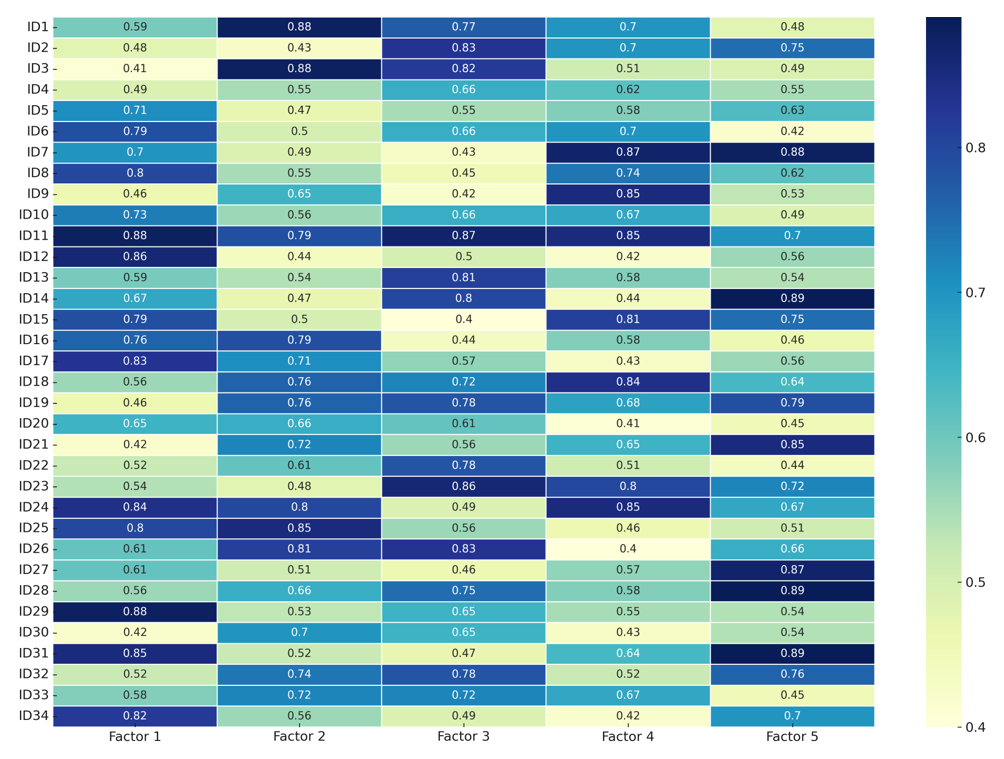
As can be seen in the graph, most of the indicators show high loadings on a single factor, which reinforces the validity of the proposed empirical structure. However, some items show relevant loadings on more than one dimension, suggesting a possible interdependence between the components of the model, especially between the dimensions of interaction, technology and production and diffusion. Table 7, corresponding to the EFA of the second construct, focusing on teachers' media competence for scientific dissemination on LinkedIn, is presented below.
Exploratory Factor Analysis of the second construct
| Indicator | Factor 1 | Factor 2 | Factor 3 | Factor 4 |
| ID1 | 0.74 | 0.41 | 0.66 | 0.51 |
| ID2 | 0.72 | 0.49 | 0.75 | 0.59 |
| ID3 | 0.87 | 0.47 | 0.57 | 0.46 |
| ID4 | 0.86 | 0.84 | 0.53 | 0.73 |
| ID5 | 0.81 | 0.68 | 0.66 | 0.52 |
| ID6 | 0.45 | 0.85 | 0.85 | 0.72 |
| ID7 | 0.57 | 0.57 | 0.76 | 0.85 |
| ID8 | 0.84 | 0.79 | 0.72 | 0.44 |
| ID9 | 0.48 | 0.85 | 0.70 | 0.40 |
| ID10 | 0.45 | 0.73 | 0.40 | 0.48 |
| ID11 | 0.67 | 0.75 | 0.73 | 0.51 |
| ID12 | 0.76 | 0.52 | 0.56 | 0.77 |
| ID13 | 0.72 | 0.82 | 0.73 | 0.68 |
| ID14 | 0.45 | 0.58 | 0.53 | 0.52 |
| ID15 | 0.89 | 0.60 | 0.85 | 0.72 |
| ID16 | 0.80 | 0.65 | 0.69 | 0.65 |
| ID17 | 0.50 | 0.76 | 0.54 | 0.41 |
| ID18 | 0.72 | 0.49 | 0.87 | 0.88 |
| ID19 | 0.86 | 0.59 | 0.41 | 0.86 |
| ID20 | 0.61 | 0.88 | 0.88 | 0.83 |
| ID21 | 0.55 | 0.59 | 0.83 | 0.56 |
| ID22 | 0.48 | 0.68 | 0.87 | 0.75 |
| ID23 | 0.69 | 0.45 | 0.71 | 0.90 |
| ID24 | 0.47 | 0.66 | 0.84 | 0.77 |
| ID25 | 0.75 | 0.75 | 0.58 | 0.55 |
| ID26 | 0.80 | 0.81 | 0.83 | 0.86 |
| ID27 | 0.66 | 0.65 | 0.80 | 0.72 |
| ID28 | 0.75 | 0.80 | 0.85 | 0.57 |
Although the TMC theoretical model for science outreach in DSN was designed with six dimensions (Language, Technology, Interaction, Production and Dissemination, Ideology and Values, Aesthetics), the EFA revealed a different empirical structure. This suggests that some theoretical dimensions may have been grouped into the same factor in practice, reflecting the interdependence between them. In particular, dimensions such as Interaction, Technology and Production and Dissemination clustered together, indicating that technological use directly influences the way knowledge is interacted with and disseminated.
To complement the matrix of factor loadings obtained in the EFA of the second construct, a heat map (Figure 2) was produced showing the concentration of high loadings on specific factors. This visual analysis reinforces the preliminary validity of the model and allows observing the empirical consistency of the indicators.
Heat map of factor loadings of the second construct
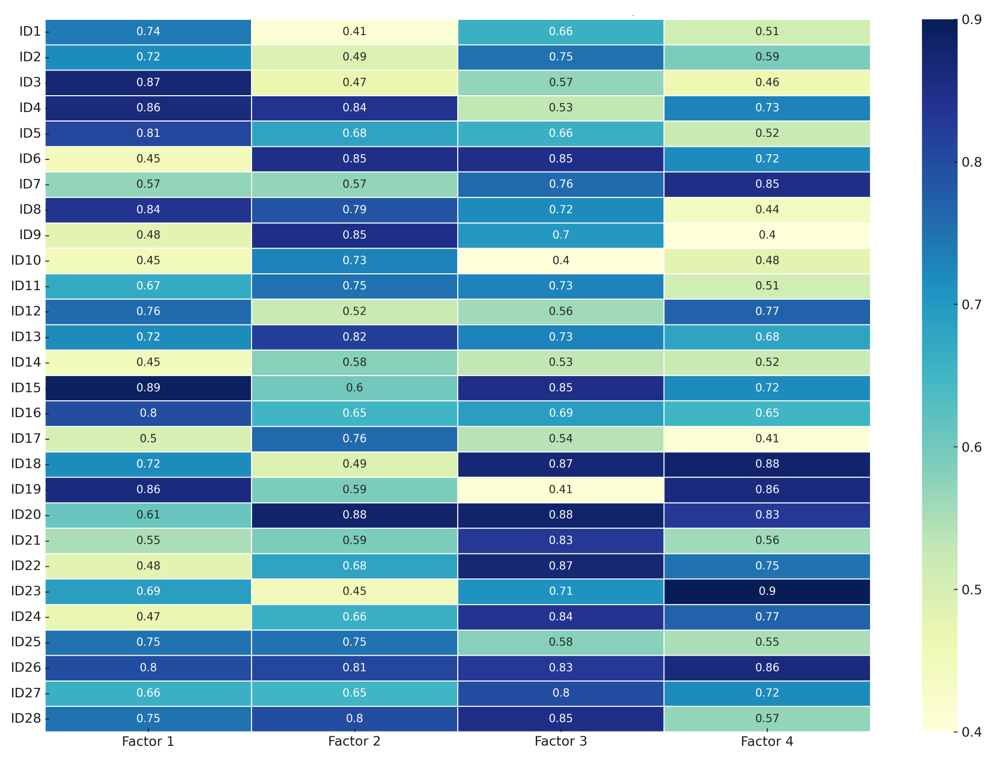
The heat map for the second construct reveals, as in the previous case, a clear concentration of high loadings around specific factors, indicating a good empirical definition of the proposed dimensions. The consistency of the results obtained in both exploratory factor analyses supports the preliminary structural validity of the instruments developed. This empirical evidence strengthens the applicability of the model in training contexts and provides a solid basis for future research into the assessment of teachers' media competence in DSN.
Reliability assessment
Reliability analysis confirmed the internal consistency of the instrument, with coefficients of α ≥ 0.70 and ω ≥ 0.70 in all dimensions.
In the first construct (TMC for science outreach on DSN), α values ranged between 0.84 and 0.89, with an overall coefficient of 0.91, while ω ranged between 0.86 and 0.91, reaching an overall value of 0.93. For the second construct (TMC for science outreach on LinkedIn), the coefficients per dimension showed a similar trend, with an overall α of 0.89 and an overall ω of 0.90. These values indicate a high internal consistency across dimensions, which reinforces the stability of the model (Table 8).
The item-total correlation analysis showed coefficients above 0.30 for all indicators, which guarantees their adequate discrimination within each dimension. No items were identified with critical values suggesting their elimination or modification. This confirms that each item contributes significantly to the measurement of the construct to which it belongs.
Results of Cronbach's Alpha and McDonald's Omega analysis
| Construct | Dimension |
Cronbach's alpha (α) |
McDonald's Omega (ω) |
| TMC for scientific dissemination in DSN | Language | 0.86 | 0.88 |
| Technology | 0.89 | 0.91 | |
| Interaction | 0.85 | 0.87 | |
| Production and Dissemination | 0.88 | 0.90 | |
| Ideology and Values | 0.87 | 0.89 | |
| Aesthetics | 0.84 | 0.86 | |
| Overall | 0.91 | 0.93 | |
| TMC for science outreach on LinkedIn | Language | 0.85 | 0.87 |
| Technology | 0.88 | 0.89 | |
| Interaction | 0.84 | 0.85 | |
| Production and Dissemination | 0.87 | 0.88 | |
| Ideology and Values | 0.86 | 0.87 | |
| Aesthetics | 0.83 | 0.84 | |
| Overall | 0.89 | 0.90 |
The EFA results showed a reduction from the initial six theoretical dimensions to five factors in DSN and four in LinkedIn. This grouping suggests conceptual integrations, particularly between the interaction, technology and production/dissemination dimensions, which tend to converge empirically. This pattern could be explained by the functional convergence that characterises teaching practice in digital environments, where networked interaction, strategic use of technology and content creation develop in an interrelated way. Moreover, the professional and academic nature of platforms such as LinkedIn seems to enhance this integration, blurring the boundaries between dimensions theoretically envisaged. These findings advance the empirical understanding of teachers' media competence, providing a basis for its critical interpretation and possible application in teacher education and scientific dissemination. Theoretical and practical implications are discussed below.
DISCUSSION AND CONCLUSIONS
The results obtained offer an empirical approach to the structure of the TMC for scientific dissemination in DSN, differentiating between the generalist use of digital platforms and scholarly communication in professional environments such as LinkedIn. The reduction of the initial theoretical dimensions and the observed groupings suggest the need to reconsider certain conceptual overlaps, in line with digital teaching practice and the functional integration of interaction, technology and content production. The high reliability indices and preliminary factorial consistency support the theoretical relevance of the instrument, in line with the MRCDD 2.2 and media literacy frameworks (Ferrés & Piscitelli, 2012). These findings are in line with previous studies that highlight the importance of strengthening TMC in academic contexts (Cabero-Almenara et al., 2020; Suelves et al., 2022).
These findings are in line with previous research that has addressed the assessment and development of digital competence in teaching from psychometric and formative perspectives. For example, Cabero-Almenara et al. (2020) validated competence frameworks through expert judgement, highlighting the importance of the analysis of internal consistency and relevance of indicators. Palacios-Rodríguez et al. (2025) conducted a comparative macroassessment between Spain and Portugal based on the DigCompEdu framework, underlining the need for more specific diagnostic approaches. At the conceptual level, studies such as Marcelo-Martínez et al. (2025) have highlighted the gap between the instrumental use of DSN and its pedagogical use in teacher education. This paper extends these contributions by integrating media literacy into the assessment of teaching competence, with a contextual specificity (LinkedIn) that has not been previously addressed.
The findings also reinforce the idea that media and digital literacy is essential in teacher education, in line with research that has assessed TMC and its pedagogical applications (Jiang & Yu, 2024; Simons et al., 2017). In particular, this study provides a differentiation between TMC in DSN and its specificity in LinkedIn, which has not been sufficiently addressed in previous studies.
However, there are discrepancies with previous studies that have addressed TMC and digital as a global construct without differentiating their specific applications in academic outreach (Ho et al., 2024; Kara et al., 2017; Luan et al., 2023; Vergili & Kara, 2024). Previous research (Palacios-Rodríguez et al., 2025) has analysed TMC in more general digital-oriented terms by highlighting media competence in general DSN and specific DSN in professional settings. This distinction brings a novel approach by highlighting that scientific communication requires specific strategies that are not fully covered in general models of teacher media literacy.
This study makes an original contribution to the field of teacher education and media literacy by proposing two distinct and empirically validated constructs for assessing teachers' media competence in science communication. Unlike previous models, the proposal presented here allows for a specific assessment for professional contexts such as LinkedIn, responding to the current demands of academic communication in digital environments. This specificity broadens the field of application of the TMC and provides a useful evaluative framework both for designing training programmes and for future research in the area.
In addition to its training applications, the validated model offers relevant implications for institutional policies in higher education. The inclusion of specific indicators on science outreach in DSN allows universities to design action plans more aligned with the principles of open science and knowledge transfer. This is particularly relevant in the context of the Sustainable Development Goals (SDGs), which promote inclusive and accessible science communication. Institutionalising the recognition of media competence as an assessable dimension in teaching careers can not only favour the visibility of research, but also a more socially connected academic culture. In this line, the proposal is articulated as a useful tool for diagnosing needs, defining training itineraries and establishing quality indicators in digital academic dissemination, aspects that are increasingly valued by quality assurance agencies and competitive calls for funding.
The results of the EFA show a factorial structure that, although it does not coincide exactly with the theoretical proposal of six dimensions, presents an organisation of the factors that is in line with previous findings in studies on media and digital competences. Several studies (García et al., 2022; Romero-Rodríguez et al., 2019) have found or assessed similar structures, where the dimensions of technology, interaction and production tend to be grouped together due to their interdependence in digital contexts. This pattern suggests that, in practice, media competences may not manifest themselves as strictly independent constructs, but as interrelated dimensions that respond to the dynamics of the digital environment. Future studies could apply a CFA to assess the stability of the model and compare it with factor structures reported in the literature.
The integration of TMC into teacher training and institutional strategies is key to strengthening science outreach in DSN. The results confirm the robustness of the content validation, supported by clear theoretical criteria and expert judgement, and provide theoretical value for future research and training programmes. LinkedIn stands out as an essential tool for the visibility of scientific production and knowledge transfer. At the institutional level, it is necessary to recognise dissemination in DSN as a legitimate academic activity and to align teacher training with the MRCDD 2.2 in order to promote media literacy.
From an applied perspective, the instruments developed offer a starting point for the diagnosis and orientation of training plans and institutional policies aimed at ethical and effective scientific dissemination. However, the factorial evidence obtained is preliminary and needs to be contrasted with large samples before a definitive model can be consolidated. Educational policies should promote the critical use of these platforms, providing resources and training in line with the principles of open science and the Sustainable Development Goals.
Limitations and lines of future work
The main limitations of the study include the small sample size (n = 30), which makes it necessary to consider exploratory factor analysis (EFA) as a preliminary approximation. Although it is a purposive sample of experts specialising in media literacy, educational technology and teacher training, the factorial validity of the instrument needs to be contrasted with large and heterogeneous samples.
As a future line, a CFA is proposed to test the proposed structure of the TMC, under a second-order hierarchical model with six dimensions grouped into a general factor. The CFA will be applied to a sample of more than 300 university teachers, using robust maximum likelihood (MLR) with AMOS and assessing the goodness of fit by means of χ²/df, CFI, TLI, RMSEA and SRMR. The empirical application of the instruments in real training contexts is also proposed in order to contrast their diagnostic usefulness, carry out cross-validation and develop test-retest reliability studies. We also plan to extend their application to international samples and compare results between different social platforms, which will allow us to reinforce their predictive validity and comparative usefulness.
Acknowledgments
Dieter Reynaldo Fuentes Cancell has been funded under the UVa 2024 predoctoral contracts call, co-funded by Banco Santander.
REFERENCES
Area, M., & Guarro, A. (2012). La alfabetización informacional y digital: fundamentos pedagógicos para la enseñanza y el aprendizaje competente. Revista Española de Documentación Científica, 35(Monográfico), 46-74. https://doi.org/10.3989/redc.2012.mono.977
Argüello-Gutiérrez, C., & Moreno-López, R. (2024). Attitudes and practices of educational researchers towards the use of social media to disseminate science. Journal of Information Science. Advance online publication. https://doi.org/10.1177/01655515241245958
Baruffaldi, S. H., Di Maio, G., & Landoni, P. (2017). Determinants of PhD holders' use of social networking sites: An analysis based on LinkedIn. Research Policy, 46(4), 740-750. https://doi.org/10.1016/j.respol.2017.01.014
Buckingham, D. (2003). Media education and the end of the critical consumer. Harvard Educational Review, 73(3), 309-327. https://doi.org/10.17763/haer.73.3.c149w3g81t381p67
Buzón, V. M., Pérez, R. G., & Catalán, Á. R. (2019). Explorando factores predictores de la competencia digital en las redes sociales virtuales. Pixel-Bit. Revista de Medios y Educación, 56(56), 51-69. https://doi.org/10.12795/pixelbit.2019.i56.03
Cabero-Almenara, J., Romero-Tena, R., & Palacios-Rodríguez, A. (2020). Evaluation of teacher digital competence frameworks through expert judgement: The use of the expert competence coefficient. Journal of New Approaches in Educational Research, 9(2), 275-283. https://doi.org/10.7821/naer.2020.7.578
Claro, M., Castro-Grau, C., Ochoa, J. M., Hinostroza, J. E., & Cabello, P. (2024). Systematic review of quantitative research on digital competences of in-service school teachers. Computers & Education, 215, 105030. https://doi.org/10.1016/j.compedu.2024.105030
DiFazio, R. L., Strout, T. D., Vessey, J. A., & Lulloff, A. (2018). Item generation and content validity of the child-adolescent bullying scale. Nursing Research, 67(4), 294-304. https://doi.org/10.1097/NNR.0000000000000283
Ferrés, J., & Piscitelli, A. (2012). La competencia mediática: propuesta articulada de dimensiones e indicadores. Comunicar, 19(38), 75-82. https://doi.org/10.3916/C38-2012-02-08
Fleiss, J. L., Levin, B., & Cho Paik, M. (2003). Statistical Methods for Rates and Proportions (3rd ed.). John Wiley and Sons. https://doi.org/10.1002/0471445428
Fuentes Cancell, D. R., Estrada Molina, O., & Delgado Yanes, N. (2021). Las redes sociales digitales: una valoración socioeducativa. Revisión sistemática. Revista Fuentes, 23(1), 41-52. https://doi.org/10.12795/revistafuentes.2021.v23.i1.11947
Gallego, A. M., Lacerda, J. D. S., & Araujo, A. C. C. (2023). La divulgación científica en Instagram: el reto del discurso audiovisual científico ante los contenidos efímeros. Revista de Comunicación de la SEECI, 56, 148-175. https://doi.org/10.15198/seeci.2023.56.e823
García, M. Á. G., Muñoz-Repiso, A. G.-V., & Duarte, M. A. A. (2022). Competencias digitales de los docentes en formación: dimensiones y componentes que promueven su desarrollo. Civilizar, 22(42), e20220105. https://doi.org/10.22518/jour.ccsh/20220105
Grizzle, A., Wilson, C., Tuazon, R., Cheung, C. K., Lau, J., Fischer, R., Gordon, D., Akyempong, K., Singh, J., Carr, P. R., Stewart, K., Tayie, S., Suraj, O., Jaakkola, M., Thésée, G., Gulston, C., Andzongo Menyeng, B. P., & Zibi Fama, P. A. (2021). Media and information literate citizens: think critically, click wisely! UNESCO. https://unesdoc.unesco.org/ark:/48223/pf0000377068
Gümüş, M. M., & Kukul, V. (2023). Developing a digital competence scale for teachers: validity and reliability study. Education and Information Technologies, 28(3), 2747-2765. https://doi.org/10.1007/s10639-022-11213-2
Hernández-Sampieri, R., & Mendoza, C. (2018). Metodología de la investigación: Las rutas cuantitativa, cualitativa y mixta (6th ed.). McGraw-Hill.
Hidalgo, M., & Hidalgo, M. (2024). Análisis del concepto de Competencia Digital Docente: una revisión sistemática de la literatura. Revista Latinoamericana de Tecnología Educativa - RELATEC, 23(1), 25-41. https://doi.org/10.17398/1695-288X.23.1.25
Ho, H. T. N., Dinh, V. H., & Phan, Q. A. (2024). The important role of New Media Literacy (NML) in Vietnam: Adaptation and Validation of the NML Scale. Communication Reports, 37(1), 28-44. https://doi.org/10.1080/08934215.2023.2272270
Hobbs, R. (2010). Digital and Media Literacy: A Plan of Action. The Aspen Institute. https://www.aspeninstitute.org/publications/digital-media-literacy-plan-action-2
Huang, L., Clarke, A., Heldsinger, N., & Tian, W. (2019). The communication role of social media in social marketing: a study of the community sustainability knowledge dissemination on LinkedIn and Twitter. Journal of Marketing Analytics, 7(2), 64-75. https://doi.org/10.1057/s41270-019-00053-8
Instituto Nacional de Tecnologías Educativas y de Formación del Profesorado (INTEF). (2022). Marco de Referencia de la Competencia Digital Docente 2.2. Ministerio de Educación y Formación Profesional. https://intef.es/wp-content/uploads/2022/03/MRCDD_V06B_GTTA.pdf
Jiang, L., & Yu, N. (2024). Developing and validating a Teachers' Digital Competence Model and Self-Assessment Instrument for secondary school teachers in China. Education and Information Technologies, 29(7), 8817-8842. https://doi.org/10.1007/s10639-023-12182-w
Kara, M., Caner, S., Günay Gökben, A., Cengiz, C., İşgör Şimşek, E., & Yıldırım, S. (2017). Validation of an instrument for preservice teachers and an investigation of their new media literacy. Journal of Educational Computing Research, 56(7), 1005-1029. https://doi.org/10.1177/0735633117731380
Knight, M. (2019). Teaching responsible social media practices in business and professional communication: the importance of LinkedIn. Business and Professional Communication Quarterly, 82(4), 399-400. https://doi.org/10.1177/2329490619884740
López-Aguado, M., & Gutiérrez-Provecho, L. (2019). Cómo realizar e interpretar un análisis factorial exploratorio utilizando SPSS. REIRE Revista d'Innovació i Recerca en Educació, 12(2), 1-14. https://doi.org/10.1344/reire2019.12.227057
Luan, L., Liang, J. C., Chai, C. S., Lin, T. B., & Dong, Y. (2023). Development of the new media literacy scale for EFL learners in China: a validation study. Interactive Learning Environments, 31(1), 244-257. https://doi.org/10.1080/10494820.2020.1774396
Marcelo-Martínez, P., Yot-Domínguez, C., & Yanes Cabrera, C. (2025). Conectados fuera, desconectados dentro. Las redes sociales en la formación inicial docente. RIED-Revista Iberoamericana de Educación a Distancia, 28(1), 83-106. https://doi.org/10.5944/ried.28.1.41343
Marchal, N., Hoes, E., Klüser, K. J., Hamborg, F., Alizadeh, M., Kubli, M., & Katzenbach, C. (2025). How Negative Media Coverage Impacts Platform Governance: Evidence from Facebook, Twitter, and YouTube. Political Communication, 42(2), 215-233. https://doi.org/10.1080/10584609.2024.2377992
Martin-Neira, J. I., Trillo-Domínguez, M., & Olvera-Lobo, M. D. (2023). El periodismo científico ante la desinformación: decálogo de buenas prácticas en el entorno digital y transmedia. Revista ICONO 14. Revista científica de Comunicación y Tecnologías emergentes, 21(1), 1-28. https://doi.org/10.7195/ri14.v21i1.1949
Olaya Guerrero, J. C., Contreras Contreras, F., & Salinas Ponce, Á. F. B. (2025). Competencias digitales en los docentes universitarios: una revisión sistemática. Revista InveCom, 5(1). https://doi.org/10.5281/zenodo.12659838
Ordóñez Castillo, G. A., Montesdeoca Estrada, S. J., Henríquez Mendoza, E. F., Santín Picoita, F. G., & Granda Cruz, C. A. (2024). Divulgación científica y plataformas digitales: Caso de los profesores de comunicación en tres universidades ecuatorianas. Estudios y Perspectivas Revista Científica y Académica, 4(3), 3147-3166. https://doi.org/10.61384/r.c.a.v4i3.602
Palacios-Rodríguez, A., Llorente-Cejudo, C., Lucas, M., & Bem-haja, P. (2025). Macroevaluación de la competencia digital docente. Estudio DigCompEdu en España y Portugal. RIED-Revista Iberoamericana de Educación a Distancia, 28(1), 177-196. https://doi.org/10.5944/ried.28.1.41379
Polit, D. F., & Beck, C. T. (2006). The content validity index: Are you sure you know what's being reported? Critique and recommendations. Research in Nursing & Health, 29(5), 489-497. https://doi.org/10.1002/nur.20147
Romero Rodríguez, J. M., Campos Soto, M. N., & Gómez García, G. (2019). Follow me y dame like: Hábitos de uso de Instagram de los futuros maestros. Revista Interuniversitaria de Formación del Profesorado, 33(1), 83-96. https://doi.org/10.47553/rifop.v33i1.72046
Romero-Rodríguez, L. M., Contreras-Pulido, P., & Pérez-Rodríguez, M. A. (2019). Media competencies of university professors and students. Comparison of levels in Spain, Portugal, Brazil and Venezuela. Cultura y Educación, 31(2), 326-368. https://doi.org/10.1080/11356405.2019.1597564
Said-Hung, E., Martín-Gutiérrez, Á., & Marcano, B. (2024). A study of social media use for scientific communication and dissemination among Spanish education researchers. Knowledge Management & E-Learning: An International Journal, 16(2), 237-258. https://doi.org/10.34105/j.kmel.2024.16.012
Simons, M., Meeus, W., & T'Sas, J. (2017). Measuring media literacy for media education: development of a questionnaire for teachers' competencies. Journal of Media Literacy Education, 9(1), 99-115. https://doi.org/10.23860/JMLE-2017-9-1-7
Suelves, D. M., Méndez, V. G., & Mas, J. A. R. L. (2022). Análisis de la competencia digital en el futuro profesorado a través de un diseño mixto. Revista de Educación a Distancia (RED), 22(70), 1-17. https://doi.org/10.6018/red.523071
Tolbert, C. L. (2024). The leadership identity presented on LinkedIn. The Journal of Values-Based Leadership, 18(1), 11. https://doi.org/10.22543/1948-0733.1539
Valencia-Oliveros, N. Y., & Martín-Gutiérrez, Á. (2024). Divulgación en RRSS de las profesoras universitarias del campo educativo en España. Profesorado, Revista de Currículum y Formación del Profesorado, 28(3), 311-331. https://doi.org/10.30827/profesorado.v28i3.29601
Vásquez-Rocca, L. (2024). Comunicación científica en Twitter. Autoría, función y estructuras prototípicas de académicos en Chile. Galáxia (São Paulo), 49, e66109. https://doi.org/10.1590/1982-2553202466109
Vergili, M., & Kara, M. (2024). An investigation of students and teachers' new media literacy: the contributing characteristics with the moderator role of gender. Research and Practice in Technology Enhanced Learning, 19, 029. https://doi.org/10.58459/rptel.2024.19029
Verstappen, M., & Opgenhaffen, M. (2024). Making it fit: how science news gets remediated for Facebook and Instagram. Journalism Studies, 25(9), 1010-1028. https://doi.org/10.1080/1461670X.2023.2263799
Viladrich, C., Angulo-Brunet, A., & Doval, E. (2017). Un viaje alrededor de alfa y omega para estimar la fiabilidad de consistencia interna. Anales de Psicología / Annals of Psychology, 33(3), 755-782. https://doi.org/10.6018/analesps.33.3.268401
Reception: 01 July 2025
Accepted: 31 July 2025
OnlineFirst: 11 October 2025
Publication: 01 January 2026